

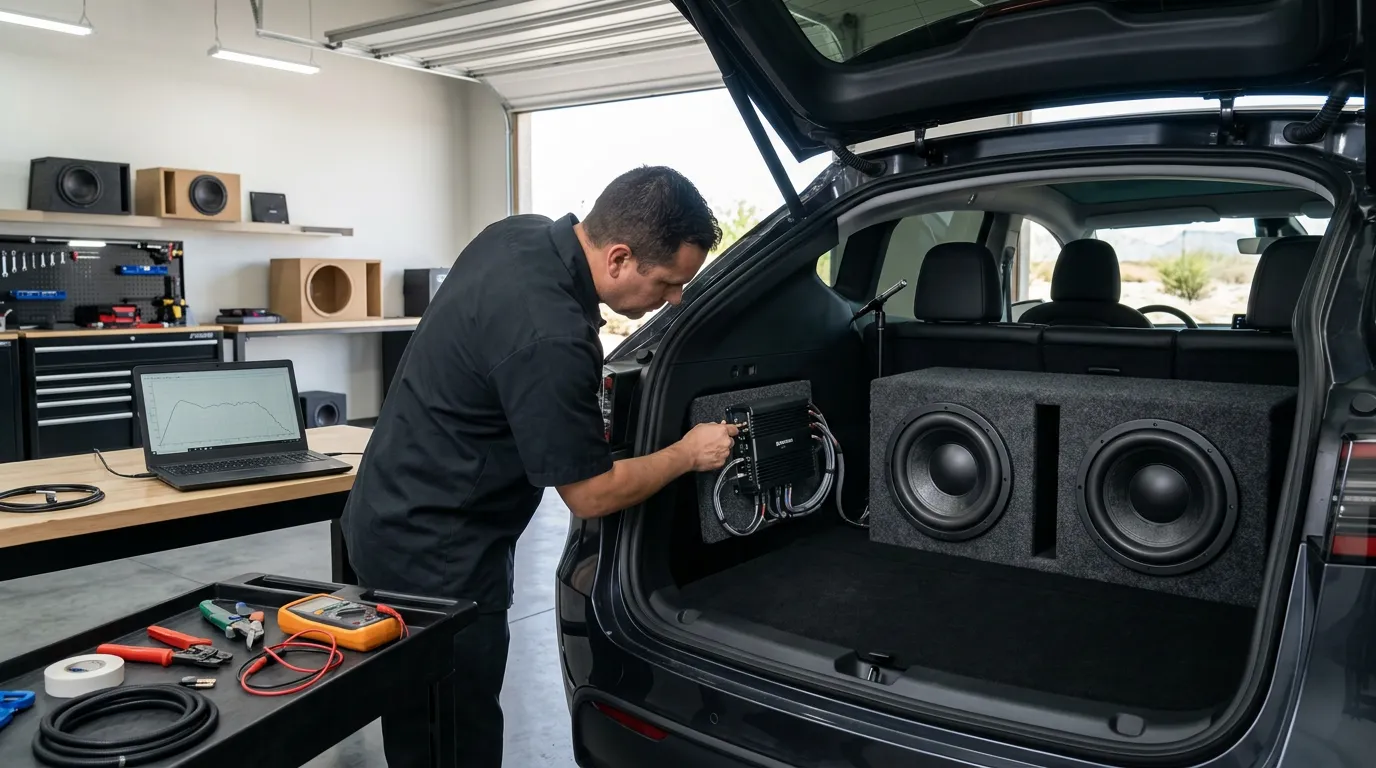
Subwoofer Installation in Las Vegas, NV, is a popular upgrade for drivers who want deeper bass without losing the clarity of their favorite music. Maybe your factory stereo sounds fine until a song reaches a low note. Maybe the bass disappears when you turn up the volume. Or perhaps you want to feel the kick drum without hearing your trunk rattle every time it hits.
A good subwoofer setup can help with all of those concerns, but getting the right sound involves more than choosing the biggest speaker you can fit.
The enclosure changes how the subwoofer performs. The amplifier needs to supply suitable power. Wiring must be installed safely, and the system needs to be tuned so the bass blends with the rest of the music.
For drivers in Las Vegas, NV, there’s another practical concern: the equipment needs to fit your vehicle and handle regular use, including time spent parked in hot weather. A large enclosure might sound impressive, but it may not work for a family SUV that carries groceries, luggage, and passengers every week.
At Dipped Auto Works, we provide professional car audio installation in Las Vegas, NV, including subwoofers, amplifiers, speaker upgrades, and custom audio systems. Our team helps vehicle owners choose equipment based on their listening preferences and the available space in their cars.
Here’s what to know about subwoofer enclosures, amplifier matching, installation, and tuning before planning your upgrade.
Table of Contents
- What Does a Subwoofer Add to Your Car?
- Choosing the Right Subwoofer Size
- Sealed vs Ported Subwoofer Enclosures
- Powered, Shallow-Mount, and Custom Subwoofer Options
- Why Enclosure Size and Placement Matter
- How to Match a Subwoofer With an Amplifier
- Understanding RMS Power, Ohms, and Voice Coils
- Adding a Subwoofer to a Factory Stereo
- Safe Amplifier Wiring and Installation
- How Professional Subwoofer Tuning Works
- Preventing Trunk Rattles and Unwanted Noise
- Subwoofer Setups for Different Vehicle Types
- Planning for Las Vegas Heat and Daily Driving
- What to Expect During Professional Installation
- Questions to Ask Before Booking
- Frequently Asked Questions
- Schedule Subwoofer Installation at Dipped Auto Works
- Sources and References
What Does Subwoofer Installation Add to Your Car Audio System?
A subwoofer is a speaker designed to reproduce low-frequency sound.
These lower notes include bass guitar, deep synthesizers, kick drums, and other sounds that smaller car speakers may struggle to reproduce accurately.
Many factory audio systems focus on delivering an acceptable balance across different types of music. Their door and dashboard speakers may not produce the low bass that you hear through a larger sound system.
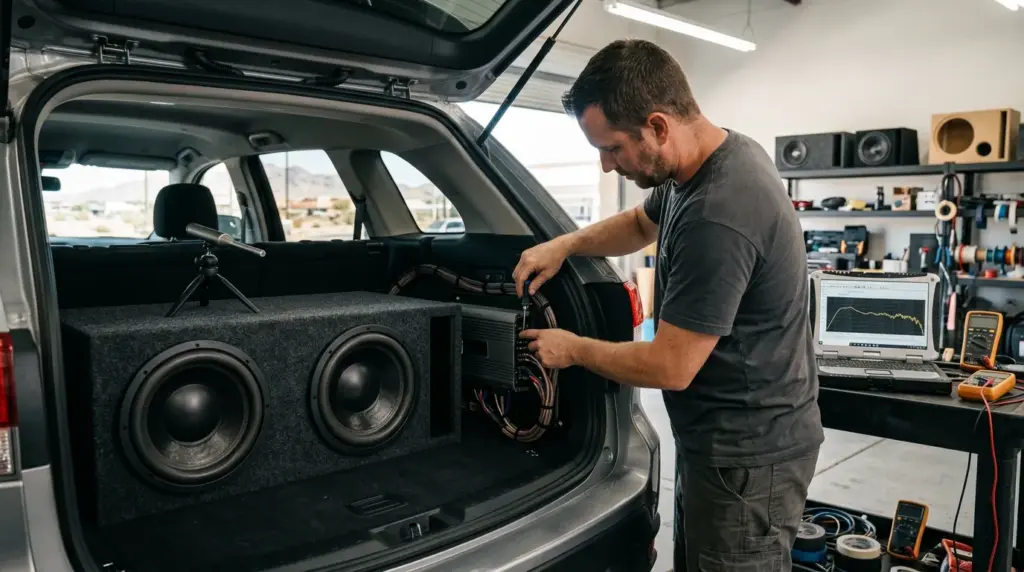
Adding a dedicated subwoofer can fill in that missing part of the music.
More Bass Doesn’t Have to Mean More Noise
Some drivers want bass they can feel.
Others simply want their music to sound fuller at a comfortable volume.
Both goals can be addressed through a properly selected system.
A compact subwoofer may provide enough depth to make acoustic music and everyday listening more satisfying.
A larger enclosure with suitable amplification may deliver stronger low-frequency output for drivers who enjoy bass-heavy music.
The right subwoofer installation should reflect what you want to hear, not just how loud the equipment can play.
Why the Existing Speakers Still Matter
A subwoofer doesn’t replace your door speakers or tweeters.
Those speakers reproduce much of the vocals, instruments, and higher-frequency details.
If the existing speakers are damaged or distorted, adding bass won’t correct those problems.
Sometimes a more balanced system requires a combination of speaker, amplifier, and subwoofer upgrades.
An installer should listen to your current setup and discuss what needs attention.
Choosing the Right Subwoofer Size for Your Vehicle
Subwoofers come in several sizes, with 8-inch, 10-inch, 12-inch, and 15-inch models among the familiar choices.
The diameter affects the physical space needed, but it doesn’t tell you everything about how the subwoofer will sound.
Enclosure design, power handling, speaker construction, and tuning all contribute to the result.
8-Inch Subwoofers
An 8-inch subwoofer may suit a vehicle where installation space is limited.
Compact systems can fit under certain seats, behind pickup truck seats, or in small cargo areas when the available clearance allows it.
These setups may appeal to drivers who want some added bass without sacrificing much usable space.
10-Inch Subwoofers
A 10-inch subwoofer can work for many everyday listening systems.
It may fit into a reasonably compact enclosure while delivering satisfying low-frequency output.
Some owners choose this size because they want deeper bass but still need practical trunk or cargo space.
12-Inch Subwoofers
Twelve-inch subs are another common choice for full-sounding bass.
They are available in sealed, ported, shallow-mount, and powered configurations.
Their actual performance depends on the model and enclosure, not the diameter alone.
15-Inch Subwoofers
Larger subwoofers can be suitable for systems where low-frequency output is a major goal.
They usually require careful planning around enclosure space, power, and installation.
A 15-inch model isn’t automatically better than a smaller, properly matched subwoofer.
What this means: Choose the subwoofer around your listening goals, available space, and the manufacturer’s installation requirements rather than size alone.
Sealed vs Ported Subwoofer Enclosures: What’s the Difference?
One of the biggest decisions in subwoofer installation is choosing the enclosure.
The enclosure is the box or housing surrounding the subwoofer.
It does more than hold the speaker in place. It affects how the speaker moves and how the low notes sound inside your vehicle.
According to Crutchfield’s guide to choosing a subwoofer box, sealed and ported enclosures produce different types of bass response.
Sealed Subwoofer Enclosures
A sealed box is an airtight enclosure.
The air trapped inside helps control movement of the subwoofer cone.
Sealed systems are often chosen for controlled, accurate bass.
They also tend to take up less space than comparable ported enclosures.
A sealed enclosure may be worth considering if you:
- Listen to many different music genres
- Want precise bass notes
- Prefer a compact trunk installation
- Need a system that doesn’t dominate the cargo area
- Want the bass to blend smoothly with the other speakers
Sealed doesn’t mean quiet.
A suitable sealed subwoofer with adequate amplification can produce strong bass.
Ported Subwoofer Enclosures
A ported enclosure includes an opening or vent designed to reinforce output over a selected frequency range.
Properly designed ported boxes can produce more output than comparable sealed enclosures at certain frequencies.
They often need more physical space.
Ported boxes may appeal to drivers who want stronger bass impact and enjoy music with sustained low-frequency notes.
But the design has to match the subwoofer.
A poorly sized or tuned port can make the system sound uneven or place unwanted stress on the speaker.
Sealed vs Ported Subwoofer Comparison
| Feature | Sealed Enclosure | Ported Enclosure |
|---|---|---|
| Construction | Airtight box | Box with tuned opening |
| Typical sound | Controlled and accurate | Stronger output around tuning range |
| Space required | Often smaller | Often larger |
| Design sensitivity | Depends on internal volume and driver | Depends on internal volume, port dimensions, and driver |
| Common use | Balanced everyday listening | Higher-output bass setups |
| Amplifier requirements | Matched to subwoofer | Matched to subwoofer and enclosure |
| Installation planning | Box fit and secure mounting | Box fit, port clearance, and secure mounting |
Is One Enclosure Always Better?
No.
A good sealed system may sound better than a poorly designed ported one.
A properly engineered ported system can also deliver deep, controlled bass.
The important part is matching the enclosure to the speaker and the sound you want.
Powered, Shallow-Mount, and Custom Subwoofer Installation Options
Not every vehicle has room for a conventional subwoofer box and separate amplifier.
There are several ways to add bass while keeping the cabin practical.
Powered Subwoofers
A powered subwoofer includes an amplifier as part of its system.
Some come in compact enclosures designed to fit under certain seats or in small cargo spaces.
Powered subs can work well when you want additional bass without designing an entire separate amplifier and enclosure setup.
They still require proper power, ground, signal connections, and secure mounting.
Shallow-Mount Subwoofers
Shallow-mount models are designed for areas where installation depth is limited.
They may fit behind truck seats or in specially designed compact enclosures.
However, a shallow subwoofer still needs the correct enclosure volume and appropriate amplification.
Crutchfield’s shallow-subwoofer guide explains how these designs can help when cargo and seating space are limited.
Loaded Subwoofer Enclosures
A loaded enclosure comes with the subwoofer already installed in a matching box.
This can simplify product selection.
You still need to confirm that the enclosure fits the vehicle and that the amplifier matches the subwoofer’s specifications.
Custom Subwoofer Enclosures
A custom enclosure is designed around the specific vehicle and chosen speaker.
It might fit along a trunk sidewall, behind a seat, or in another suitable location.
Custom fabrication can be useful when you want to preserve cargo space or create a more integrated appearance.
At Dipped Auto Works, our custom car audio services include subwoofer and amplifier setups designed around different vehicle interiors.
Why Subwoofer Box Size and Placement Matter
An enclosure’s exterior dimensions don’t tell you its usable internal air volume.
The thickness of the box walls, the subwoofer itself, internal bracing, and any port structures can all reduce the available space inside.
The manufacturer’s enclosure recommendations should guide the design.
What Happens If the Box Is the Wrong Size?
A box that’s too small or too large for the selected subwoofer can change its response and cone movement.
The result may include weak bass, uneven output, or unwanted speaker stress.
For ported systems, both internal volume and port tuning matter.
An installer should use the manufacturer’s enclosure specifications rather than guessing based on what will fit.
Does Subwoofer Direction Change the Sound?
It can.
A subwoofer facing the rear of a sedan may sound different from the same speaker facing the rear seats.
Trunk shape, seat construction, and cabin acoustics affect what occupants hear.
In Crutchfield’s enclosure placement test, changing the position of a subwoofer enclosure produced noticeable differences in measured bass output.
That doesn’t establish one mounting direction as the best for every car.
It means placement deserves testing when practical.
Keep the Box Secure
A subwoofer enclosure should never be left loose in a cargo area.
A heavy box can move during sudden braking or a collision.
The installer should use suitable mounting methods that keep the enclosure in place without interfering with vehicle safety systems.
Also consider access to the spare tire, battery compartment, storage areas, and folding seats.
How Do You Match a Subwoofer With an Amplifier?
A subwoofer needs enough suitable electrical power to reproduce bass without excessive distortion.
For most component subwoofers, that means using an external amplifier.
But buying the amplifier with the biggest advertised wattage isn’t the right starting point.
You need to compare continuous power ratings and the electrical load created by the speaker wiring.
Focus on RMS Power
RMS wattage describes continuous power handling or output under specified conditions.
A subwoofer’s RMS rating and an amplifier’s RMS output are more useful for matching equipment than peak or maximum-power marketing figures.
Crutchfield’s subwoofer and amplifier matching guide explains that the amplifier’s output must be considered at the impedance of the connected subwoofer system.
Why Amplifier Matching Matters
An amplifier that cannot supply enough clean power for the intended listening level may be driven into distortion.
An amplifier that delivers more power than the speaker can safely handle can also cause damage when operated improperly.
The goal is a compatible combination with suitable settings.
Do You Need a Separate Subwoofer Amplifier?
Not always.
A powered subwoofer has amplification built in.
A component subwoofer usually needs a separate amplifier or suitable amplified channel.
A dedicated mono amplifier is one common option for a single subwoofer system.
The right amplifier depends on the speaker configuration and existing audio equipment.
Understanding RMS Power, Impedance, and Voice Coils
You don’t need to become an audio technician to understand these terms, but knowing what they mean helps you compare installation plans.
What Does Ohm Mean in Car Audio?
Ohms describe electrical impedance.
Subwoofers are commonly available in configurations involving 2-ohm or 4-ohm voice coils, among others.
An amplifier may produce different levels of power depending on the connected impedance.
The final electrical load must remain within the amplifier manufacturer’s rated limits.
Single vs Dual Voice Coil Subwoofers
A single voice coil subwoofer has one voice coil.
A dual voice coil subwoofer has two voice coils, which can provide different wiring arrangements.
The final impedance depends on the coil configuration and how multiple coils or speakers are connected.
A dual voice coil design doesn’t automatically mean twice the bass.
It gives the installer additional ways to match the speaker system to the amplifier.
Why Wiring Choices Matter
Connecting speakers in series or parallel changes the electrical load seen by the amplifier.
The wiring plan must be made before final equipment selection.
Crutchfield provides subwoofer wiring diagrams that illustrate compatible configurations.
A professional installer should verify the actual equipment ratings and wiring rather than selecting a configuration solely to produce the lowest possible impedance.
Can You Install a Subwoofer Without Replacing the Factory Stereo?
Yes, in many vehicles.
This is good news if you like your existing dashboard, touchscreen, steering wheel controls, and factory entertainment features.
You may be able to add bass without replacing the original stereo.
How Does the Installer Get an Audio Signal?
Aftermarket amplifiers need an appropriate audio signal.
Some factory systems do not have the RCA preamp outputs found on aftermarket receivers.
Depending on the vehicle and amplifier, an installer may use speaker-level inputs or a line output converter.
A line output converter, often called an LOC, converts a compatible speaker-level signal into a signal suitable for an amplifier input.
Crutchfield’s guide to adding a subwoofer to a factory stereo explains this approach.
What About Factory Bass Reduction?
Some factory audio systems reduce bass output at higher volume levels.
This can interfere with how an aftermarket subwoofer responds.
Certain audio integration products include signal correction or bass-restoration features intended to address that behavior.
The installer should evaluate the factory system before choosing an interface.
What About Vehicles With Factory Amplifiers?
A premium factory sound system may use more complicated wiring, signal processing, and speaker configurations.
An aftermarket subwoofer may still be possible, but it requires a vehicle-specific integration plan.
The technician should identify a suitable audio signal and avoid interfering with existing vehicle functions.
Why Safe Wiring Matters During Subwoofer Installation
Subwoofer installation isn’t only about sound.
Amplifiers draw electrical current, and incorrect wiring can cause overheating, short circuits, electrical damage, or other problems.
A properly installed system needs suitable wiring, grounding, protection, and mounting.
Amplifier Power Wiring
The amplifier needs a power supply appropriate for its electrical requirements.
Cable size depends on the equipment, current draw, wire length, and installation conditions.
According to Crutchfield’s amplifier power wire fuse guide, a suitable fuse located close to the power source protects the power cable against dangerous short-circuit conditions.
The fuse and wiring should be selected according to the amplifier, cable, and vehicle requirements.
Ground Connections
A poor ground connection can cause amplifier problems, unwanted noise, and unreliable operation.
The installer should use an approved grounding location and suitable connection hardware.
Cable Routing
Wires should be protected from sharp metal edges, moving components, heat, moisture, and abrasion.
The installation must also avoid interfering with seat operation, airbags, restraint wiring, and other safety equipment.
Amplifier Ventilation
Amplifiers generate heat when operating.
They need suitable airflow based on the manufacturer’s installation instructions.
An amp should not be hidden in a tightly enclosed space that prevents it from cooling properly.
Extra Care With Modern and Electric Vehicles
Some newer cars and electric vehicles have electrical architectures that differ from conventional vehicles.
For those vehicles, the shop should confirm the correct integration procedure before adding equipment.
High-voltage EV components require special handling and should never be used as a connection point for aftermarket audio equipment.
A careful installation preserves the vehicle’s existing safety and electrical functions.
How Professional Subwoofer Tuning Works
After the equipment is installed, it still needs to be adjusted.
A subwoofer can have the right amplifier and enclosure but sound disappointing if the system isn’t tuned properly.
Tuning helps the bass blend with the other speakers instead of overwhelming them.
Crutchfield’s subwoofer tuning guide covers gain, crossovers, bass boost, and infrasonic filtering.
Step 1: Check the Audio Signal for Distortion
The installer should assess the signal reaching the amplifier.
Distortion can begin before the volume control reaches its highest setting.
The technician may use appropriate test signals and measurement equipment to identify suitable operating levels.
Step 2: Set the Amplifier Gain
Amplifier gain adjusts input sensitivity.
It is not simply another volume knob.
Setting the gain incorrectly can produce excessive noise or distortion.
The amplifier should be matched to the input signal and the subwoofer’s capabilities.
Step 3: Adjust the Low-Pass Crossover
A low-pass filter limits the higher frequencies sent to the subwoofer.
That allows the subwoofer to concentrate on bass while the other speakers reproduce more of the vocals and instruments.
Some systems begin crossover adjustments in the general area of 80 Hz, but this is not a universal setting.
The final choice depends on the speakers, enclosure, vehicle acoustics, and system design.
Step 4: Blend Bass With the Other Speakers
The installer listens for gaps or excessive overlap between the subwoofer and the other speakers.
The goal is for music to sound connected rather than as though the bass comes from a separate box in the trunk.
Phase adjustment, crossover changes, or other tuning tools may help.
Step 5: Review Bass Boost and Infrasonic Filtering
Bass boost can emphasize selected low frequencies, but excessive boosting may introduce distortion or overload the system.
Some ported enclosures also benefit from an infrasonic filter selected around the enclosure’s tuning requirements.
Not every system needs the same settings.
The technician should follow the subwoofer and amplifier manufacturers’ instructions.
Step 6: Test Different Music
A system shouldn’t only sound good with one bass-heavy song.
Testing several familiar tracks can reveal overly strong notes, weak areas, or distortion.
A properly tuned system should reproduce bass in a way that fits your preferences while staying within the equipment’s operating limits.
How to Reduce Trunk Rattles After Subwoofer Installation
Stronger bass can cause interior panels, license plates, trunk lids, and loose objects to vibrate.
Some vibration comes from the vehicle itself rather than the subwoofer.
A rattle doesn’t automatically mean the speaker is defective.
Find the Source Before Changing the System
Common sources include:
- Loose license plates
- Trunk trim
- Rear deck panels
- Loose cargo
- Interior clips
- Unsecured wiring
- Enclosure movement
- Loose exterior accessories
A technician should identify which areas are making noise before recommending additional treatment.
Can Sound Damping Help?
Yes.
Sound-damping materials can reduce vibrations in certain metal panels and interior components.
Crutchfield’s vibration-damping installation guide identifies the trunk floor, trunk lid, and doors as areas that may benefit from treatment.
Results depend on the vehicle and the source of the noise.
Why Enclosure Mounting Is Important
An unsecured box can move and create unwanted noises.
Proper mounting helps reduce movement and is also important for occupant safety.
Ask the installer how the enclosure will be secured.
Should You Turn the Bass Down If Something Rattles?
If the system is creating strong unwanted vibration, lower the level until the cause can be inspected.
Trying to overpower the rattle by increasing the bass only makes the problem harder to identify.
Subwoofer Installation for Sedans, Trucks, SUVs, and Luxury Cars
Different vehicles offer different amounts of installation space.
A setup that works well in a large SUV may not fit behind the seats of a pickup truck.
Subwoofers for Sedans
The trunk is a common location for a subwoofer enclosure.
A compact sealed box may preserve more storage space.
A larger ported box may suit owners who want stronger low-frequency output and can spare the room.
The installer should also consider the rear seats and how bass travels into the cabin.
Subwoofers for Pickup Trucks
Pickup trucks often have limited space behind or under the rear seats.
Shallow-mount subwoofers and custom enclosures may help.
Seat movement, passenger legroom, and vehicle storage compartments need to be considered.
Subwoofers for SUVs
SUVs can provide more flexibility because their rear cargo areas often open directly into the passenger cabin.
But a heavy enclosure must be secured properly.
If the vehicle regularly carries luggage, equipment, or pets, a compact or side-mounted arrangement may be preferable.
Subwoofers for Tesla and Other EVs
Modern EVs may have factory audio systems and electrical configurations that require special integration.
Any installation should be planned around the vehicle manufacturer’s electrical and safety requirements.
The goal is to add bass without interfering with existing systems, seat operation, or safety components.
Custom Audio for Luxury and Performance Vehicles
Luxury vehicles sometimes have factory amplifiers, signal processing, and tightly integrated entertainment systems.
An installer may need an interface or other equipment to add a subwoofer without losing existing features.
Dipped Auto Works provides custom car audio installation for vehicle owners interested in more involved sound systems.
Subwoofer Installation in Las Vegas, NV: Heat and Daily Driving Considerations
Vehicle use matters just as much as the equipment.
In Las Vegas, NV, cars may spend long periods in outdoor parking areas during the summer.
The National Weather Service documents the city’s prolonged summer heat.
That doesn’t mean subwoofers cannot perform reliably here.
It means installation and ventilation deserve attention.
Keep Amplifiers Properly Ventilated
An amplifier generates heat during operation.
A well-planned installation should allow the unit to dissipate that heat as its manufacturer intended.
Avoid covering amplifier ventilation areas with cargo or loose materials.
If you notice repeated thermal shutdowns, have the system inspected.
Secure Equipment for Everyday Use
Think about how often you carry passengers or cargo.
A subwoofer box that blocks access to the spare tire or prevents seats from folding may become frustrating.
A good installation plan should balance audio performance and vehicle use.
Don’t Ignore Changes in Sound
If the system starts buzzing, distorting, shutting down, or making unusual noises, reduce the volume and arrange an inspection.
Possible causes include loose connections, damaged equipment, excessive gain, or enclosure problems.
Continuing to run a system that is malfunctioning may make the damage worse.
Keep Listening Levels Comfortable
Very loud music can contribute to hearing damage.
The CDC’s hearing loss prevention guidance explains that prolonged exposure to loud sounds can damage hearing.
Enjoy your bass while keeping volume at a level that allows you to hear traffic and other important sounds around your vehicle.
What to Expect During Professional Subwoofer Installation
Professional subwoofer installation in Las Vegas, NV, should begin with a conversation about the sound you want.
You don’t need to arrive knowing which amplifier or enclosure you need.
The shop should help you review your vehicle, existing audio system, and available installation space.
Step 1: Discuss Your Listening Preferences
Tell the installer:
- What music you listen to
- Whether you prefer controlled or hard-hitting bass
- Whether you need to keep most of your cargo space
- Whether you want to keep your factory stereo
- If you have any existing audio equipment
- Whether you want the equipment hidden or visible
These details help guide the system design.
Step 2: Inspect the Vehicle
The technician checks the available space and the existing audio configuration.
The shop should identify possible mounting locations and review any vehicle-specific electrical or interior concerns.
Step 3: Choose the Subwoofer and Enclosure
The installer can explain the differences between sealed, ported, powered, shallow-mount, and custom setups.
The enclosure should fit both the chosen speaker and the vehicle.
Step 4: Match the Amplifier and Wiring
The equipment needs compatible RMS ratings and impedance.
The shop plans power, grounding, signal connections, and mounting based on the system requirements.
Step 5: Install and Secure the Components
The technician installs the subwoofer, amplifier, signal interface where needed, and suitable wiring.
The enclosure and amplifier should be mounted safely.
Step 6: Tune and Test the System
The installer adjusts the gain, crossover, and other controls.
The finished system should be checked for distortion, unwanted rattles, and reliable operation.
Step 7: Review the Finished Installation
At pickup, ask for an explanation of the equipment, bass controls, warranty information, and any care instructions.
You should know how to adjust the bass without changing amplifier settings that were established during tuning.
Questions to Ask Before Booking Subwoofer Installation in Las Vegas, NV
Use this checklist when comparing car audio installers.
- Can I keep my factory stereo and controls?
- Which subwoofer size fits my vehicle?
- Would a sealed or ported enclosure suit my listening preferences?
- Is a powered or shallow-mount subwoofer an option?
- What RMS power is the subwoofer rated to handle?
- What amplifier will be used?
- Is the amplifier compatible with the final impedance?
- Where will the equipment be mounted?
- How will the power wiring be protected?
- Will the enclosure be secured?
- Will I still have access to vehicle storage areas?
- Does the factory stereo need a signal interface?
- How will amplifier gain and crossovers be tuned?
- Can existing rattles be inspected?
- What warranty applies to the equipment and installation?
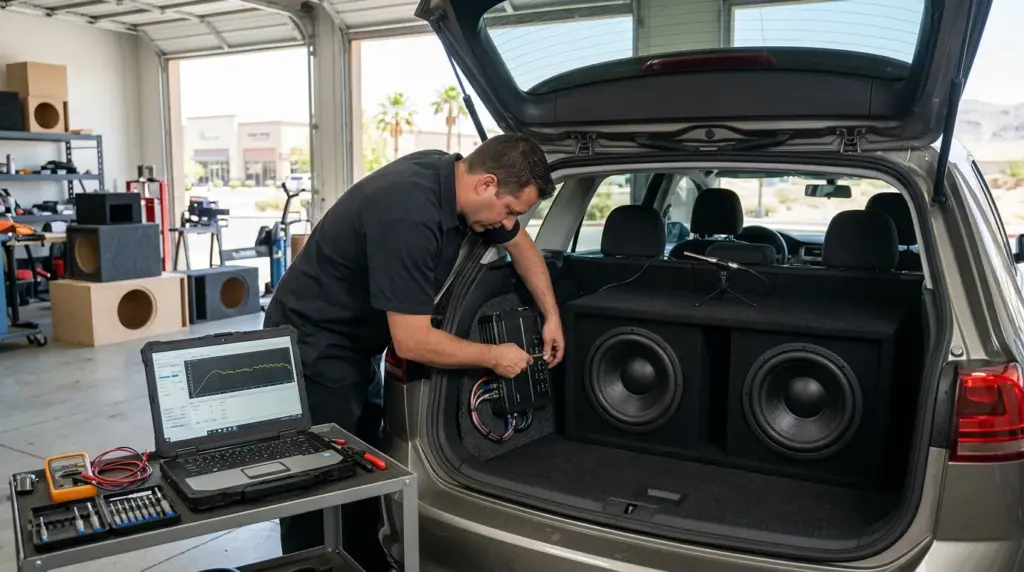
A useful consultation should leave you knowing why the selected equipment makes sense for your vehicle.
Subwoofer Installation in Las Vegas, NV: 7 Frequently Asked Questions
1. Is a sealed or ported subwoofer box better for my car?
A sealed enclosure is often chosen for controlled bass and a smaller installation footprint.
A ported enclosure may deliver stronger output in its designed frequency range but typically requires more space.
Neither is automatically better.
The right choice depends on the specific subwoofer, enclosure design, vehicle, and listening preferences.
2. Can I add a subwoofer without replacing my factory stereo?
Yes, in many vehicles.
A subwoofer can sometimes be connected using compatible speaker-level amplifier inputs or a line output converter.
Some factory systems require more involved integration.
An installer should inspect the existing stereo before recommending equipment so you can retain suitable factory functions.
3. How much amplifier power do I need for a subwoofer?
The amplifier should be matched to the subwoofer’s RMS power handling and the final impedance of the speaker system.
A larger advertised peak-wattage number does not automatically mean better performance.
Ask your installer to explain the RMS ratings and the expected electrical load.
Proper amplifier tuning also matters.
4. Is one 12-inch subwoofer better than two 10-inch subwoofers?
Not necessarily.
The result depends on the individual speakers, total cone area, enclosure design, amplifier power, and vehicle acoustics.
Two smaller subwoofers may offer different output characteristics from one larger speaker, but either setup can perform well when designed correctly.
Compare the complete systems rather than only their speaker diameters.
5. Will a subwoofer installation make my trunk rattle?
Stronger bass can cause loose trim, license plates, trunk panels, or other components to vibrate.
The amount varies by vehicle and system output.
Secure enclosure mounting and suitable vibration-damping treatments may help.
Ask the installer to inspect any rattles during final testing.
6. How long does professional subwoofer installation take?
Installation time depends on the vehicle, equipment, wiring requirements, and enclosure design.
A compact powered subwoofer may involve less work than a custom enclosure with separate amplification and factory audio integration.
Dipped Auto Works can discuss the expected installation schedule after reviewing your vehicle and audio goals.
7. Where can I get professional subwoofer installation in Las Vegas, NV?
You can schedule a consultation with Dipped Auto Works, located at 4305 Dean Martin Dr #120, Las Vegas, NV 89103.
Our team provides subwoofer installation, amplifier installation, speaker upgrades, and custom car audio services.
Call (702) 379-8716 or visit our contact page to request an appointment.
Schedule Subwoofer Installation in Las Vegas, NV, at Dipped Auto Works
A well-planned subwoofer system can make your music sound deeper and fuller without overwhelming the rest of the audio.
The best result comes from choosing equipment that works together.
The enclosure needs to suit the speaker. The amplifier must match the electrical requirements. Wiring needs proper protection, and tuning should bring the bass into balance with your existing speakers.
At Dipped Auto Works, we help drivers in Las Vegas, NV, plan car audio upgrades based on their vehicles and listening preferences.
Whether you want a compact under-seat subwoofer, a sealed trunk enclosure, a larger ported setup, or a custom audio installation, our team can discuss the available options.
We also serve vehicle owners coming from surrounding communities, including Henderson, NV, North Las Vegas, NV, and Summerlin, NV.
Our services include:
- Car Audio Installation
- Custom Car Audio Systems
- Subwoofer Installation
- Amplifier Installation
- Speaker Upgrades
- Custom Subwoofer Enclosures
- Factory Stereo Integration
- Audio System Tuning
- Vehicle Customization
Our team can review your current system, explain equipment options, and discuss the installation details for your vehicle.
Contact Dipped Auto Works
Business Name: Dipped Auto Works
Address: 4305 Dean Martin Dr #120, Las Vegas, NV 89103
Phone: (702) 379-8716
Business Hours: Monday through Saturday, 9 AM to 6 PM
Website: www.dippedautoworks.com
Schedule an Appointment: Contact Dipped Auto Works
Want deeper bass without sacrificing clear sound?
Call (702) 379-8716 or fill out our contact form to request a subwoofer installation consultation.
Tell us your vehicle’s year, make, and model, whether you have a factory or aftermarket stereo, and what kind of bass you’re hoping to hear.
Our team can help you compare enclosures, amplifiers, placement options, and tuning requirements before you schedule your installation.
Sources and References
The following sources support the information about subwoofer enclosure design, amplifier matching, electrical wiring, factory stereo integration, tuning, noise reduction, and local car audio services.
1. How to Choose a Subwoofer Box
- Publisher: Crutchfield
- Publication Date: Not listed on the referenced page
- URL: https://www.crutchfield.com/learn/sealed-or-ported-subwoofer-enclosures.html
2. How to Match Subwoofers and Amplifiers
- Publisher: Crutchfield
- Publication Date: Not listed on the referenced page
- URL: https://www.crutchfield.com/learn/how-to-match-subwoofers-and-amplifiers.html
3. Subwoofer Installation Guide
- Publisher: Crutchfield
- Publication Date: Not listed on the referenced page
- URL: https://www.crutchfield.com/learn/how-to-install-a-car-subwoofer.html
4. Car Amplifier Power Wire Fuses
- Publisher: Crutchfield
- Publication Date: Not listed on the referenced page
- URL: https://www.crutchfield.com/learn/car-amplifier-power-wire-fuses.html
5. Tuning Your Subs
- Publisher: Crutchfield
- Publication Date: Not listed on the referenced page
- URL: https://www.crutchfield.com/learn/car/subwoofers/tuning.html
6. How to Add a Subwoofer to a Factory Stereo
- Publisher: Crutchfield
- Publication Date: Not listed on the referenced page
- URL: https://www.crutchfield.com/learn/adding-an-amplifier-to-a-factory-stereo.html
7. What Are Line Output Converters?
- Publisher: Crutchfield
- Publication Date: Not listed on the referenced page
- URL: https://www.crutchfield.com/learn/what-are-line-output-converters.html
8. Vibration Damping Installation Guide
- Publisher: Crutchfield
- Publication Date: Not listed on the referenced page
- URL: https://www.crutchfield.com/learn/learningcenter/car/vibration_damping_installation_guide.html
9. 1991-2020 Climate Normals
- Publisher: National Weather Service, NOAA
- Publication Date: Climate normals released in 2021; webpage date not listed
- URL: https://www.weather.gov/vef/1991-2020Normals
10. Car Audio Installation
- Publisher: Dipped Auto Works
- Publication Date: Not listed
- URL: https://dippedautoworks.com/services/car-audio-installation/
11. Custom Car Audio in Las Vegas, NV
- Publisher: Dipped Auto Works
- Publication Date: Not listed
- URL: https://dippedautoworks.com/service/custom-car-audio-in-las-vegas-nv/
12. Vehicle Customization
- Publisher: Dipped Auto Works
- Publication Date: Not listed
- URL: https://dippedautoworks.com/services/vehicle-customization/
Best Color Change Wraps in Las Vegas, NV: A Comprehensive Guide

Discover the best color change wraps in Las Vegas, NV, with Dipped Auto Works. From choosing the perfect color to expert installation, learn how to transform your car with a vinyl wrap that suits your style and protects your vehicle. Call (702) 379-8716 to schedule your consultation today!
Product Brand: Dipped Auto Works
5
Pros
- Discover the best color change wraps in Las Vegas, NV, with Dipped Auto Works. From choosing the perfect color to expert installation, learn how to transform your car with a vinyl wrap that suits your style and protects your vehicle. Call (702) 379-8716 to schedule your consultation today!
