
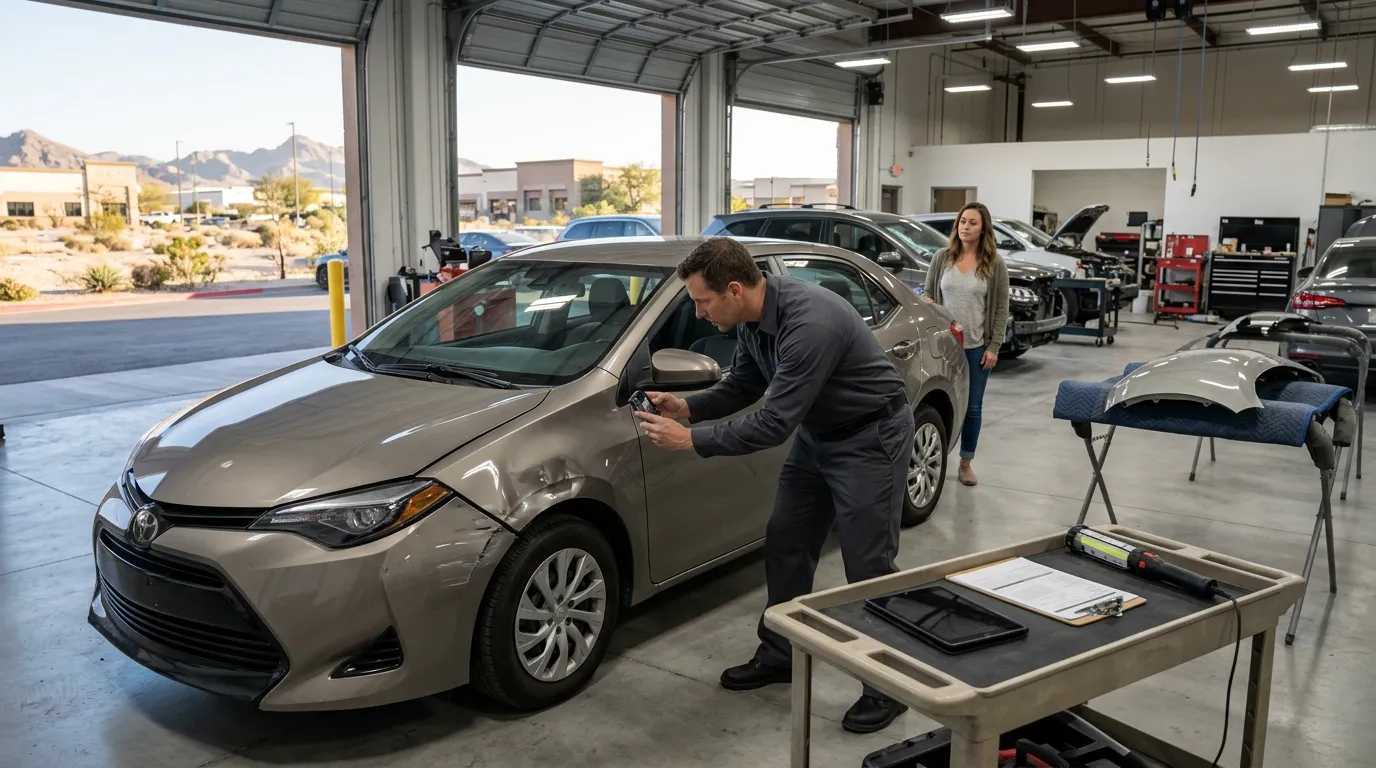
Collision Repair With Insurance in Las Vegas, NV, can feel confusing when you’re dealing with vehicle damage, an insurance adjuster, repair estimates, and questions about what happens next. Whether someone hit your parked car, you were involved in a rear-end collision, or your vehicle suffered more serious accident damage, understanding how the insurance claim process works can make the experience easier to manage.
After an accident, many vehicle owners have the same questions. Should you contact your insurance company or a body shop first? Can you choose where your car gets repaired? What happens if the repair shop finds damage that the insurance adjuster missed? And who decides when the repairs can begin?
The good news is that collision repair follows a series of steps. Once you know what to expect, you can keep your paperwork organized, ask better questions, and understand the responsibilities of your insurance provider and repair shop.
At Dipped Auto Works, we provide professional collision repair services in Las Vegas, NV. Our certified team handles accident-related bodywork, structural repairs, paint matching, and refinishing. We also work with most major insurance providers and assist customers with repair documentation.
This guide explains the collision insurance claim process, your rights under Nevada law, and what happens from the first damage inspection to picking up your repaired vehicle.
Table of Contents
- How Collision Repair With Insurance Works
- What to Do Immediately After an Accident
- Step 1: File Your Insurance Claim
- Step 2: Understand Your Insurance Coverage
- Step 3: Choose Your Collision Repair Shop
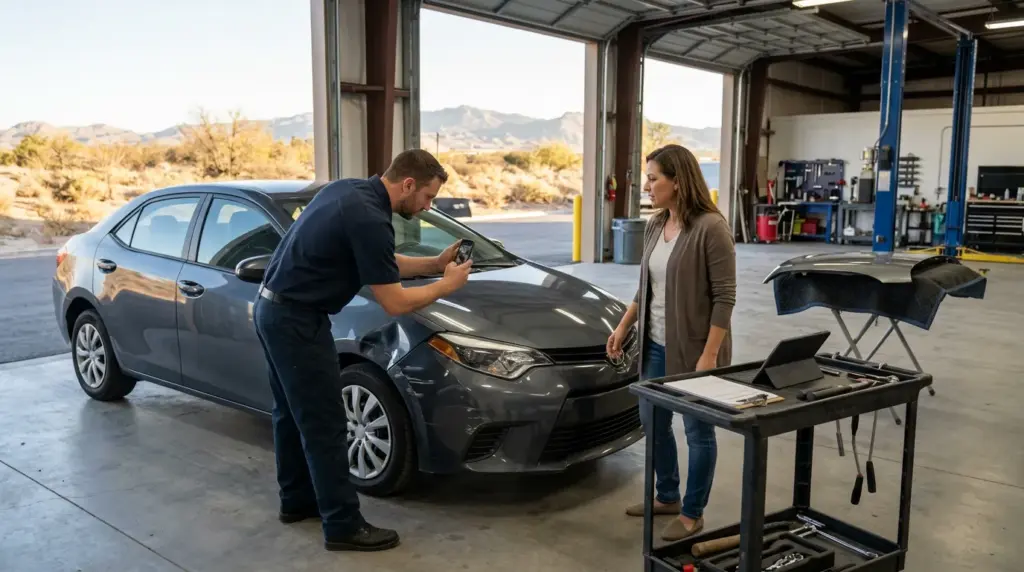
- Step 4: Vehicle Inspection and Insurance Estimate
- Step 5: Hidden Damage and Supplemental Claims
- Step 6: Insurance Approval and Repair Authorization
- Step 7: Bodywork, Paint, and Safety-System Checks
- Step 8: Final Inspection and Claim Completion
- How Long Does an Insurance Collision Repair Claim Take?
- What If Your Insurance Company Disagrees With the Shop?
- What Happens If Your Vehicle Is a Total Loss?
- Your Collision Insurance Claim Checklist
- Why Choose Dipped Auto Works for Insurance Repairs?
- Frequently Asked Questions
- Schedule Collision Repair in Las Vegas, NV
- Sources and References
How Does Collision Repair With Insurance Work in Las Vegas, NV?
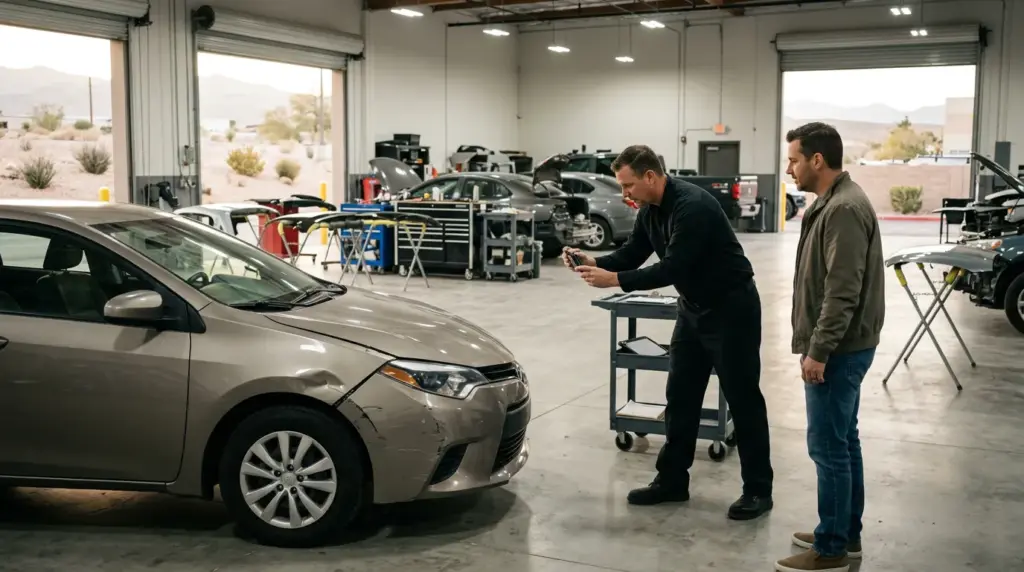
Collision repair with insurance generally involves three parties: the vehicle owner, the insurance company, and the body shop.
Each has a different responsibility.
The vehicle owner reports the accident, supplies the requested information, selects a repair facility, and authorizes the work.
The insurance company investigates the claim, reviews coverage, assesses the damage, and decides which repairs or losses are covered under the applicable policy.
The body shop inspects the vehicle, prepares a repair plan, documents damage, and performs the authorized repairs.
These responsibilities overlap during the process, but they aren’t interchangeable.
The Typical Insurance Collision Repair Process
Most claims follow a sequence similar to this:
- Report the accident and document the damage.
- Open an insurance claim and receive a claim number.
- Confirm the applicable insurance coverage.
- Select a licensed collision repair shop.
- Have the vehicle inspected.
- Review the initial repair estimate.
- Address any hidden damage discovered during disassembly.
- Obtain the required repair authorizations.
- Complete the bodywork, refinishing, and required safety checks.
- Review the completed repairs and finalize the claim.
Your exact experience may differ depending on the accident, the insurance company, and the condition of your vehicle.
Can a Body Shop Help With the Insurance Process?
Yes.
Many body shops communicate with insurance adjusters, prepare damage documentation, and submit repair supplements.
At Dipped Auto Works, we assist customers with collision repair claims and work with most major insurance companies.
Our team can explain the repairs your vehicle needs and help provide the documentation requested during the claim.
Your insurer still decides coverage under the policy, and you remain responsible for reviewing and authorizing your repair agreement.
What to Do Immediately After a Car Accident in Las Vegas, NV
Before worrying about estimates or repairs, make sure everyone involved is safe.
If someone is injured, contact emergency services. Follow the instructions of responding authorities, and do not operate a vehicle that may be unsafe.
Once the immediate situation is under control, start documenting what happened.
Gather Accident Information
When safe, collect:
- The date and location of the collision
- Photos of your vehicle’s damage
- Photos of other involved vehicles
- Contact information for the people involved
- Insurance information for the involved motorists
- Witness contact information, when available
- The police report or incident number, if one exists
- Notes about how the accident happened
Photograph the damaged areas from several angles.
It can also help to photograph nearby undamaged panels so the body shop has a record of the vehicle’s condition.
Don’t Ignore Damage That Looks Minor
A scratched bumper might seem like a simple cosmetic problem.
But modern bumpers can contain reinforcement components, sensors, mounting brackets, and electrical wiring.
Even if the painted bumper cover looks repairable, other parts behind it may need inspection.
If you notice new warning messages, unusual sounds, fluid leaks, or problems with steering, arrange for the vehicle to be inspected rather than assuming it is safe.
Check Nevada Accident Reporting Requirements
An insurance claim does not automatically replace a required accident report.
The Nevada Department of Motor Vehicles explains that an SR-1 crash report may be required within 10 days when an accident was not investigated at the scene by law enforcement and resulted in reportable injury, death, or property damage.
Review the DMV’s current reporting conditions and instructions to determine whether the requirement applies.
Step 1: File Your Collision Insurance Claim
The insurance claim officially begins when you notify the appropriate insurance company.
For some vehicle owners, this means calling their own insurer.
For others, it means contacting the insurance company covering the person who caused the collision.
Which path makes sense depends on the circumstances and available coverage.
What Information Will the Insurance Company Ask For?
You may need to provide:
- Your policy information
- The date and location of the accident
- Your vehicle’s make, model, and year
- A description of the damage
- Accident photographs
- Information about other involved parties
- A police report number, if available
- The current location of your vehicle
Provide accurate information about what you know.
If you’re unsure about a detail, say so rather than guessing.
What Is an Insurance Claim Number?
After opening the claim, the insurance company usually assigns a claim number.
You’ll use this number when speaking with the adjuster, supplying documents, and communicating about the vehicle’s repairs.
Keep it somewhere easy to find.
You should also save the adjuster’s name, contact information, and any written instructions you receive.
Should You Wait for an Adjuster Before Contacting a Body Shop?
You can contact a collision repair shop to discuss an inspection while the insurance process is underway.
Ask your insurer whether it needs to inspect the vehicle before disassembly or repairs begin.
This is worth confirming because removing damaged parts before the requested inspection may complicate documentation.
At Dipped Auto Works, you can schedule a collision repair consultation and explain whether you’ve already opened an insurance claim.
Step 2: Understand Which Insurance Coverage Applies
Not every accident is handled under the same type of insurance coverage.
This is one reason collision repair with insurance in Las Vegas, NV, can follow different paths from one claim to another.
Collision Coverage
Collision coverage generally addresses damage to your own vehicle from an accident involving another vehicle or object, subject to the terms of your policy.
It may apply whether or not another motorist is responsible for the accident.
Ask your insurer about the applicable deductible and any coverage limitations.
Property Damage Liability Coverage
When another insured motorist is responsible for damaging your vehicle, you may submit a third-party property damage claim to that person’s insurer.
That insurance company must investigate liability and determine coverage.
A claim against another motorist’s insurer may involve different procedures from a claim under your own collision coverage.
Comprehensive Coverage
Comprehensive coverage generally addresses certain events other than vehicle collisions, such as theft, vandalism, falling objects, or weather-related damage, depending on the policy.
Although a body shop may repair damage arising from these events, the insurance claim may be handled under comprehensive coverage rather than collision coverage.
What About Deductibles?
A deductible is the portion of a covered claim assigned to the policyholder under the applicable policy terms.
Whether one applies depends on the coverage used and the claim circumstances.
Do not assume that every accident produces the same deductible obligation.
Your insurance provider can explain which coverage applies, how payment will be handled, and whether a deductible is involved.
Is a Rental Car Covered During Repairs?
Rental reimbursement or substitute transportation benefits depend on the policy and claim.
Some policies include rental benefits, while others do not.
A third-party claim may involve separate consideration of reasonable transportation needs, depending on liability and applicable requirements.
Ask the insurer about eligibility, authorization, and the covered rental period before arranging transportation.
Step 3: Choose Your Collision Repair Shop in Las Vegas, NV
One of the most common questions about collision repair with insurance is whether you must use the body shop recommended by your insurer.
In Nevada, you have the right to choose a licensed body shop.
Under Nevada Revised Statutes NRS 690B.016, insured motorists and claimants may select the licensed body shop where their vehicle will be repaired.
The law also requires insurers to notify customers of that right when first contacted about a motor vehicle damage claim.
What Is an Insurance-Preferred Body Shop?
Some insurance companies maintain networks of repair facilities.
An insurer may recommend a shop from its network because the business has an established working relationship with the company.
You can consider that recommendation, but Nevada law does not allow the insurer to require you to use a particular licensed body shop.
Your choice of shop does not change the actual coverage stated in your insurance policy.
What Should You Look for in a Collision Repair Shop?
Ask the repair facility about:
- Nevada body shop licensing
- Technician training and certifications
- Experience with your vehicle’s make and model
- Structural repair capabilities
- Automotive paint matching
- Replacement parts and repair procedures
- Electronic diagnostics and calibration arrangements
- Insurance claim documentation
- Workmanship warranties
- Communication during repairs
A shop should explain which services it performs and whether any specialized work will be completed by another qualified provider.
Why Choose Dipped Auto Works?
Dipped Auto Works offers auto body repair and collision repair in Las Vegas, NV.
Our services include body panel repair, frame straightening when appropriate, paint matching, refinishing, and insurance claim assistance.
We work with most major insurance companies and back our collision repair workmanship with warranties.
Ask our team about your vehicle’s damage and the repair procedures that may be needed.
Step 4: Vehicle Inspection and the Insurance Repair Estimate
After choosing a body shop, the next stage is evaluating the accident damage.
The insurance company may use an adjuster, photographs, a virtual assessment, or an in-person inspection to create its initial estimate.
The repair shop may also prepare its own estimate based on the damage and required repair procedures.
What Does an Insurance Adjuster Do?
The adjuster investigates the claim and evaluates information needed to determine the insurer’s responsibilities.
The adjuster may:
- Review accident photographs
- Inspect visible vehicle damage
- Review repair documentation
- Evaluate the proposed repair operations
- Check applicable coverage
- Request more information
- Review supplemental damage reports
The insurance adjuster and body shop technician may identify different details during their inspections.
That doesn’t automatically mean one assessment is dishonest.
An early estimate is often based on damage visible before the vehicle is taken apart.
What Should a Collision Repair Estimate Include?
A repair estimate may describe:
- Damaged exterior panels
- Repair or replacement operations
- Parts required
- Paint and refinishing work
- Structural measurements when appropriate
- Vehicle disassembly
- Reassembly
- Diagnostic inspections
- Sensor or camera calibration when required
- Outside specialist services when necessary
The repair plan should reflect the vehicle’s condition and manufacturer’s procedures.
Does Nevada Require Written Repair Estimates?
Nevada has written estimate and repair authorization requirements under NRS Chapter 487.
Covered body shops must provide written estimates when the statutory conditions apply, unless a permitted written waiver has been executed.
The law also addresses notification of certain repair changes and the information that must appear on the completed repair statement.
Before signing repair paperwork, ask the shop to explain the estimate, authorization, and any applicable storage or diagnostic terms.
Step 5: What Happens When the Body Shop Finds Hidden Damage?
Hidden damage is one of the biggest reasons an initial insurance estimate may change.
When a technician removes a damaged bumper, fender, door panel, or other component, previously covered damage may become visible.
This is a common situation during collision repair with insurance.
What Is an Insurance Repair Supplement?
A supplement is a request to revise an existing repair assessment because more work, parts, or procedures have been identified.
It may be submitted after the shop discovers damage that couldn’t be fully evaluated during the first inspection.
For instance, a vehicle may arrive with a cracked front bumper.
After removal, the technician discovers a damaged bumper reinforcement, broken mounting components, or affected sensor brackets.
The shop may need to document those findings and request an update to the insurance repair assessment.
Does the Shop Need to Contact the Insurance Company?
When the newly discovered work affects an insurance claim, the shop may provide supporting photographs, repair procedures, and updated documentation to the insurer.
The adjuster reviews the information and determines how the requested work fits the claim and policy.
Sometimes the insurer requests another inspection or further records.
Does a Supplement Mean the Shop Made a Mistake?
Not necessarily.
The original assessment may have been limited to visible damage.
Removing panels often reveals conditions that couldn’t be confirmed from the outside.
The question is whether the additional repair operations are supported by the vehicle’s actual condition and applicable repair procedures.
Can Repairs Continue While the Supplement Is Being Reviewed?
It depends on the work, the authorization already granted, and the applicable repair agreement.
Nevada Revised Statutes NRS 487.6877 through 487.6881 address notification, written waivers, and authorization when certain additional repair charges arise.
A shop should not assume that newly discovered work has been authorized simply because the vehicle is already on its premises.
Ask how repair supplements are handled and whether they may affect the schedule.
Step 6: Insurance Approval and Collision Repair Authorization
A repair estimate, an insurance coverage decision, and an authorization to perform repairs are separate things.
Understanding the difference can prevent misunderstandings.
Insurance Approval
The insurer determines which reported losses are covered and evaluates the submitted repair operations under the policy and applicable law.
Approval may come with conditions or requests for supporting documents.
Insurance companies also may communicate directly with the chosen repair facility.
Customer Repair Authorization
The person authorized to approve repairs signs or otherwise provides the required authorization for the shop to perform the agreed work.
Read the repair agreement before signing.
If the shop recommends repairs beyond the insured loss, ask how those services will be handled separately.
What If the Insurance Estimate and Shop Estimate Differ?
Differences may arise from:
- Repair versus replacement decisions
- Parts selection
- Hidden damage
- Vehicle manufacturer procedures
- Refinishing requirements
- Structural measurements
- Diagnostic procedures
- Sensor calibration needs
The shop may submit records supporting its repair plan.
The insurer may request clarification or another inspection.
Both the shop and insurer have responsibilities, but they perform different jobs.
The repair facility must follow applicable manufacturer specifications and the authorized repair agreement.
Why Communication Matters
Ask the shop who will update you when:
- Insurance approval is received
- Replacement parts are ordered
- More damage is discovered
- A supplement is submitted
- The repair schedule changes
- The vehicle is ready for inspection
Clear communication makes it easier to understand what is happening rather than guessing about the claim’s status.
Step 7: Bodywork, Paint Matching, and Vehicle Safety Checks
Once the appropriate approvals and authorizations are in place, the shop can perform the agreed repairs.
The exact work depends on the severity and location of the damage.
Some vehicles need only exterior bodywork.
Others require structural repairs, mechanical inspections, replacement parts, and electronic system checks.
Body Panel Repair and Replacement
Damaged bumpers, fenders, doors, and other body panels may be repaired or replaced according to their condition and manufacturer requirements.
The technician must determine whether the damaged component can be repaired safely or needs replacement.
Structural Repairs
A stronger accident can affect frame rails, mounting points, and other structural areas.
The shop may need to measure the vehicle’s structure and compare it with manufacturer specifications.
Not all structural components can be straightened or repaired using the same methods.
At Dipped Auto Works, our body shop services include structural work and frame straightening when the vehicle and damage are suitable.
Automotive Paint Matching
After body repairs, refinishing helps restore the appearance of damaged panels.
The technician may use factory paint codes, color samples, and matching equipment to select the appropriate paint formula.
Metallic and pearl finishes can require extra attention because their appearance changes under different lighting.
Our collision repair services include paint matching and restoration.
What About Cameras and Collision Sensors?
Many modern vehicles contain cameras, radar equipment, parking sensors, and other electronic systems.
A collision may affect these systems even if the damage appears cosmetic.
The I-CAR Collision Repair Diagnostics Definitions explain the roles of pre-repair scanning, post-repair scanning, and calibration.
A diagnostic scan can identify stored electronic fault information.
Calibration may be required after certain components are removed, repaired, replaced, or disturbed.
The exact procedures depend on the vehicle manufacturer’s instructions.
Ask whether your vehicle requires electronic diagnostics or calibration and how those operations will be completed and documented.
Step 8: Final Inspection, Insurance Payment, and Vehicle Pickup
After the authorized repairs are completed, the body shop should inspect the finished work.
This stage is about more than appearance.
The shop should confirm that the repaired components and affected systems have received the checks required by the repair plan.
What Should the Final Inspection Include?
Depending on the collision, the inspection may cover:
- Paint matching and finish appearance
- Bumper and panel alignment
- Door, hood, and trunk operation
- Lighting and exterior trim
- Sensor and camera operation
- Required diagnostic results
- Calibration documentation
- Vehicle warning messages
- Replacement part installation
- Cleanliness of the repaired areas
Not every vehicle requires the same tests.
How Does Insurance Payment Work?
Insurance payment may be issued to the policyholder, the repair facility, or jointly to parties with an interest in the vehicle.
The method depends on the policy, claim, repair agreement, and ownership or financing arrangements.
Confirm how payment will be handled before pickup.
If a deductible applies, your insurer and repair shop should explain the payment arrangement.
What Paperwork Should You Receive?
Ask for:
- A final repair statement
- A description of completed repairs
- Information about replaced parts
- Relevant diagnostic or calibration records
- Workmanship warranty documentation
- Paint care instructions
- Contact information for any follow-up concerns
Nevada law includes requirements for final statements of repair charges under NRS 487.6893.
Take a few minutes to review the paperwork and inspect the vehicle with the shop before leaving.
How Long Does Collision Repair With Insurance Take in Las Vegas, NV?
There is no single timeline that applies to every insurance collision repair.
A repair involving a bumper cover and refinishing may be more straightforward than damage affecting structural parts, electronics, and several body panels.
The insurance claim and physical repair schedule are also different.
What Affects the Insurance Claim Timeline?
Several things can influence how long the claim takes:
- Accident documentation
- Liability investigation
- Insurance coverage questions
- Vehicle inspection availability
- Repair estimate review
- Hidden damage documentation
- Supplemental claim review
- Replacement part availability
- Repair authorization
- Required diagnostics and calibrations
An insurer may resolve a straightforward claim sooner than one involving disputed fault or complicated damage.
Does Nevada Have Insurance Claim Handling Deadlines?
Yes. Nevada has insurance claim handling requirements under NAC 686A.665 through NAC 686A.675.
These rules address acknowledging claims, investigating losses, communicating with claimants, and handling decisions after required proof is received.
Some deadlines are measured in working days, and the rules allow for certain circumstances where more investigation time is needed.
Those insurance requirements do not mean your collision repairs must physically be completed within the same period.
Ask your insurer for a claim status update if you haven’t received the information you expected.
Can a Shop Promise a Completion Date?
The shop may offer an estimated repair schedule after inspecting the damage.
That date can change if hidden damage is found, parts are unavailable, or additional procedures are required.
Dipped Auto Works publishes general collision repair scheduling information, but your actual completion plan depends on the inspected damage and repair scope.
Our team can explain the expected schedule for your vehicle during your consultation.
What If Your Insurance Company and Body Shop Disagree?
Sometimes the insurance adjuster and repair shop disagree about a proposed repair.
This can involve replacement parts, repair methods, supplemental damage, or manufacturer-required procedures.
Don’t assume the disagreement automatically means the shop or insurer is wrong.
Start by asking each party to explain its position.
Ask for the Reason in Writing
If an insurer declines a repair operation, ask for a written explanation identifying the policy or claim basis for its decision.
If the body shop believes that operation is necessary, ask for the supporting repair procedure or damage documentation.
This gives everyone a clearer picture of what needs to be resolved.
Review Nevada’s Claims Handling Rules
NRS 686A.310 identifies unfair insurance claim settlement practices.
These include certain failures to respond reasonably promptly, investigate claims appropriately, or explain denials and settlement decisions.
Whether a particular action violates the law depends on its facts.
Contact the Nevada Division of Insurance
If you’ve tried resolving a claim concern directly with the insurer and still need assistance, you can contact the Nevada Division of Insurance.
Its Consumer Services Section reviews insurance-related inquiries and complaints.
The Division can investigate concerns involving improper claim delays or denials, but it does not act as your attorney or provide legal representation.
Keep your correspondence, claim number, repair documents, and the insurer’s written explanations available.
If the dispute involves injury, liability, or a legal deadline, consider seeking advice from a qualified attorney.
What Happens if Your Vehicle Is Declared a Total Loss?
Sometimes the insurance company determines that a damaged vehicle should be handled as a total loss rather than repaired.
This decision depends on the applicable law, insurance policy, vehicle condition, and claim assessment.
What Does Total Loss Mean?
A total loss determination generally means that the insurer is settling the vehicle damage claim based on its total-loss assessment rather than approving the proposed repair plan.
The process can involve evaluating the vehicle’s pre-accident condition, market value, and other relevant factors.
What Should You Ask the Insurer?
If your vehicle is declared a total loss, request an explanation of:
- How the determination was reached
- How the vehicle was valued
- Which coverage applies
- Whether financing or leasing affects payment
- What documentation you need to provide
- What happens to the damaged vehicle
- How to dispute an incorrect vehicle description or valuation
Don’t assume an initial repair estimate guarantees the vehicle will ultimately be repaired.
More serious damage discovered later can affect the insurance company’s assessment.
Can You Still Contact a Body Shop?
Yes.
A body shop can inspect the vehicle, explain observed damage, and provide relevant repair documentation.
The insurer remains responsible for making its coverage and claim determination under the applicable policy.
Collision Repair With Insurance: Your Las Vegas Claim Checklist
Keeping your documents together helps you answer questions from the insurer and body shop.
Use this checklist as you move through the claim process.
After the Accident
- Confirm everyone is safe.
- Contact emergency services when necessary.
- Photograph the vehicle damage.
- Collect involved parties’ insurance information.
- Save the accident or police report number.
- Check whether a Nevada DMV crash report is required.
- Arrange towing if the vehicle may be unsafe.
When Filing the Insurance Claim
- Report the accident to the appropriate insurer.
- Save your claim number.
- Record the adjuster’s name and contact information.
- Confirm the coverage being reviewed.
- Ask about deductible requirements.
- Ask about rental or substitute transportation benefits.
- Request written instructions for the inspection.
Before Collision Repairs Begin
- Select a licensed body shop.
- Discuss existing and suspected damage.
- Review the repair estimate.
- Ask about manufacturer repair procedures.
- Ask about replacement parts.
- Review authorization documents before signing.
- Confirm how repair supplements will be handled.
- Discuss the expected repair schedule.
Before Vehicle Pickup
- Review completed repairs.
- Inspect paint and panel alignment.
- Check affected lights and electronic features.
- Ask about required diagnostic and calibration records.
- Review the final repair statement.
- Confirm insurance payment arrangements.
- Obtain warranty documents.
- Ask about care instructions for newly refinished paint.
You don’t need to memorize the whole process.
Keeping these questions handy can make conversations with your adjuster and repair shop more productive.
Why Choose Dipped Auto Works for Collision Repair With Insurance in Las Vegas, NV?
A collision can leave you juggling insurance paperwork, repair questions, and transportation plans.
Working with a body shop that understands accident repairs and insurer documentation can help you stay informed.
At Dipped Auto Works, we provide professional auto body and collision repair services from our location at 4305 Dean Martin Dr #120, Las Vegas, NV 89103.
Insurance Claim Assistance
We work with most major insurance providers and assist customers with repair-related documentation.
Our team can explain what an inspection reveals, discuss the proposed repairs, and communicate repair information as needed.
Insurance coverage decisions remain with the insurer.
Body and Structural Repairs
Our collision repair service includes body panel repairs, component replacement, structural work, and frame straightening when appropriate for the vehicle.
The repair plan depends on the damage and the manufacturer’s requirements.
Paint Matching and Refinishing
After body repairs, our team can restore damaged painted surfaces through appropriate preparation and refinishing.
We use paint matching methods to help repaired panels blend with surrounding finishes.
Learn more about our body shop services.
Warranty-Backed Workmanship
Dipped Auto Works carries warranties on its products and services, including collision repair workmanship.
Ask us about the written warranty associated with your repair.
Paint Protection After Repairs
Once newly refinished paint is ready for protective products, we can also discuss:
These services are separate from collision repair and are not automatically included in insurance coverage.
Always follow the refinisher’s curing instructions before applying protective film or coatings to newly painted panels.
Collision Repair With Insurance in Las Vegas, NV: 7 Frequently Asked Questions
1. Can I choose my own body shop for an insurance claim in Las Vegas, NV?
Yes.
Under Nevada Revised Statutes NRS 690B.016, an insured person or claimant may choose a licensed body shop for motor vehicle repairs.
Your insurance company may recommend a repair facility, but it cannot require you to use a particular licensed shop.
Contact Dipped Auto Works if you would like to discuss having your vehicle inspected at our facility.
2. Do I need to contact insurance before bringing my car to a body shop?
You can contact a body shop to discuss the damage before the insurance claim is complete.
But you should notify your insurance provider promptly according to your policy and ask whether an insurer inspection is required before disassembly.
If you’ve already opened a claim, bring your claim number and adjuster’s information to the appointment.
Our team can discuss the inspection process and repair documentation.
3. What happens if the insurance estimate misses hidden damage?
The repair shop may discover more damage after removing affected panels or components.
The shop can document the findings and submit a supplemental repair request.
The insurer reviews the new information under the policy and applicable claim requirements.
The repair shop must also follow Nevada’s applicable notification and authorization rules for additional work.
4. Will insurance cover all collision repairs?
Coverage depends on the policy, claim circumstances, applicable exclusions, and insurance company’s determination.
Some claims involve a deductible or repairs that are not covered.
A body shop’s recommendation does not automatically mean the insurer must approve every proposed operation.
Ask your insurer for a written explanation of coverage decisions and discuss disputed repair procedures with the shop.
5. Can Dipped Auto Works communicate with my insurance company?
Yes.
Dipped Auto Works works with most major insurance providers and assists customers with collision repair documentation and communication.
We can explain the damage assessment and provide information about repair operations.
The insurance company still investigates the claim and makes coverage decisions.
Contact our team to discuss your insurer and the status of your claim.
6. How long does insurance collision repair take in Las Vegas, NV?
The timeline depends on the damage, insurance investigation, parts availability, repair authorizations, and the work required.
Hidden damage and supplemental claim reviews may extend the schedule.
A body shop can provide an expected repair schedule after assessing the vehicle, but that schedule may change as more information becomes available.
Ask for updates during the repair process.
7. Where can I schedule collision repair with insurance in Las Vegas, NV?
You can contact Dipped Auto Works, located at 4305 Dean Martin Dr #120, Las Vegas, NV 89103.
Our certified team provides collision repair, car accident repair, bodywork, structural repair, and paint restoration.
We work with most major insurance providers and offer warranty-backed workmanship.
Call (702) 379-8716 or visit our contact page to request a consultation.
Schedule Collision Repair With Insurance in Las Vegas, NV, at Dipped Auto Works
Dealing with a vehicle accident is difficult enough without having to guess what happens with your insurance claim.
Understanding the process can help you make informed decisions from the first inspection through final pickup.
Start by documenting the accident, contacting the appropriate insurer, and choosing a licensed collision repair shop.
Review the repair estimate, ask how hidden damage will be handled, and make sure you understand the required authorizations.
If something changes during the repairs, ask for an explanation and updated documentation.
At Dipped Auto Works, we help vehicle owners in Las Vegas, NV, with collision repairs and insurance-related repair documentation.
Our certified team provides:
- Collision Repair
- Car Accident Repair
- Auto Body Repair
- Body Shop Services
- Structural and Frame Repair
- Bumper and Fender Repair
- Dent and Body Panel Repair
- Automotive Paint Matching
- Paint Refinishing
- Insurance Claim Assistance
Whether your vehicle has cosmetic damage or needs a more involved accident repair assessment, our team can review its condition and explain the repair process.
Contact Dipped Auto Works
Business Name: Dipped Auto Works
Address: 4305 Dean Martin Dr #120, Las Vegas, NV 89103
Phone: (702) 379-8716
Business Hours: Monday through Saturday, 9 AM to 6 PM
Website: www.dippedautoworks.com
Schedule an Appointment: Contact Dipped Auto Works
Have an insurance claim for collision damage?
Call (702) 379-8716 or fill out our contact form to request a collision repair consultation.
Tell us your vehicle’s year, make, and model, describe the damage, and let us know whether you’ve already received an insurance claim number.
Our team can help you understand the inspection process, discuss the repairs your vehicle may need, and explain how we assist with insurance-related repair documentation.
Sources and References
The following sources support the information about Nevada insurance claims, body shop selection rights, repair authorization, supplemental repairs, accident reporting, collision diagnostics, and Dipped Auto Works services.
1. NRS 690B.016: Right to Choose a Licensed Body Shop
- Publisher: Nevada Legislature
- Publication Date: Originally enacted in 1989; current statutory compilation revised April 15, 2026
- URL: https://www.leg.state.nv.us/NRS/NRS-690B.html#NRS690BSec016
2. NRS Chapter 487: Repair, Removal and Disposal of Vehicles
- Publisher: Nevada Legislature
- Publication Date: Sections amended in different years; current online compilation revised April 15, 2026
- URL: https://www.leg.state.nv.us/NRS/NRS-487.html
3. NAC Chapter 686A: Insurance Claims Settlement Practices
- Publisher: Nevada Legislature
- Publication Date: Applicable claim handling regulations have different effective dates; online compilation date not listed
- URL: https://www.leg.state.nv.us/NAC/NAC-686A.html
4. NRS 686A.310: Unfair Practices in Settling Claims
- Publisher: Nevada Legislature
- Publication Date: Originally enacted in 1975; current online compilation revised April 15, 2026
- URL: https://www.leg.state.nv.us/NRS/NRS-686A.html#NRS686ASec310
5. File a Complaint
- Publisher: Nevada Division of Insurance
- Publication Date: Not listed; online consumer guidance
- URL: https://doi.nv.gov/Consumers/File_a_Complaint/
6. Nevada DMV Forms: Report of Traffic Crash
- Publisher: Nevada Department of Motor Vehicles
- Publication Date: Webpage date not listed; current online forms directory
- URL: https://dmv.nv.gov/dmvforms.htm
7. Collision Repair Diagnostics Definitions
- Publisher: I-CAR
- Publication Date: October 3, 2016; validated in 2025
- URL: https://rts.i-car.com/crn-646.html
8. Collision Repair
- Publisher: Dipped Auto Works
- Publication Date: Not listed
- URL: https://dippedautoworks.com/services/collision-repair/
9. Auto Body Repair Shop
- Publisher: Dipped Auto Works
- Publication Date: Not listed
- URL: https://dippedautoworks.com/services/auto-body-repair-shop/
10. Car Accident Repair
- Publisher: Dipped Auto Works
- Publication Date: Not listed
- URL: https://dippedautoworks.com/services/car-accident-repair/
11. Body Shop Services
- Publisher: Dipped Auto Works
- Publication Date: Not listed
- URL: https://dippedautoworks.com/services/body-shop/
Best Color Change Wraps in Las Vegas, NV: A Comprehensive Guide

Discover the best color change wraps in Las Vegas, NV, with Dipped Auto Works. From choosing the perfect color to expert installation, learn how to transform your car with a vinyl wrap that suits your style and protects your vehicle. Call (702) 379-8716 to schedule your consultation today!
Product Brand: Dipped Auto Works
5
Pros
- Discover the best color change wraps in Las Vegas, NV, with Dipped Auto Works. From choosing the perfect color to expert installation, learn how to transform your car with a vinyl wrap that suits your style and protects your vehicle. Call (702) 379-8716 to schedule your consultation today!
