
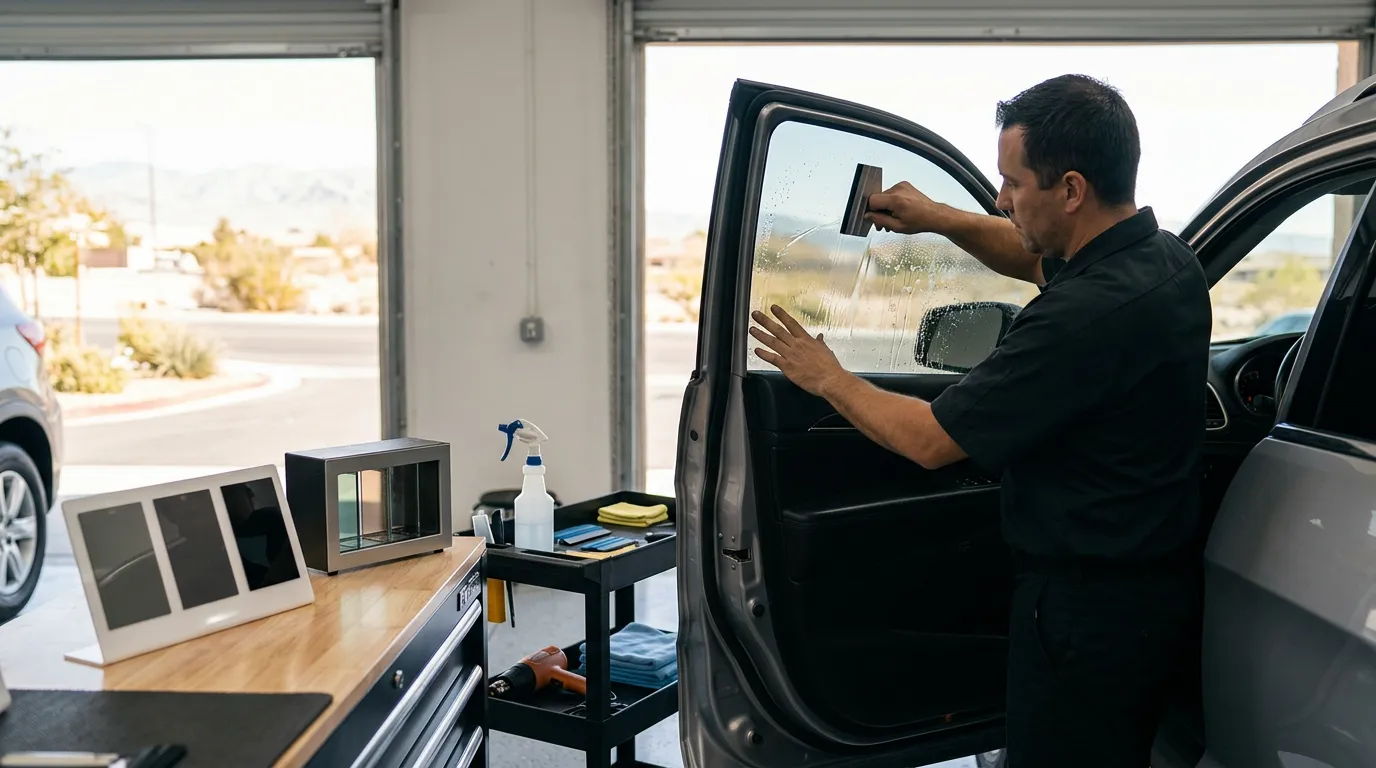
Window tint near Nellis Air Force Base, NV, is worth considering if you’re tired of stepping into a hot vehicle after a long day, dealing with sunlight through your side windows, or watching your interior collect the effects of years of sun exposure. Whether you own a truck, SUV, Tesla, sports car, or everyday commuter, the right automotive window film can help reduce incoming solar heat, limit glare, and make your cabin more comfortable.
But choosing window tint isn’t as simple as picking the darkest shade available. Carbon and ceramic films have different properties, and a darker appearance doesn’t always mean better heat rejection. Nevada also has window tint regulations that affect which films and shades can be installed on different windows.
For vehicle owners near Nellis Air Force Base, NV, and throughout the Northeast Valley, these details matter. Hot summer afternoons, outdoor parking, and regular travel can make interior comfort a concern. Knowing how to compare window films can help you select a product that works for your vehicle without sacrificing visibility or overlooking legal requirements.
At Dipped Auto Works, we offer professional automotive window tinting for vehicle owners throughout the Las Vegas, NV, area, including those coming from communities near Nellis Air Force Base, NV. Our certified installation team offers carbon and ceramic window tint packages with warranty-backed services.
Let’s look at the available film options, how they handle heat and UV exposure, and what to ask before scheduling your window tint appointment.
Table of Contents
- Why Window Tint Matters Near Nellis Air Force Base
- How Automotive Window Tint Works
- Carbon Window Tint Options
- Ceramic Window Tint Options
- Carbon vs Ceramic Window Tint Comparison
- Understanding Window Tint Heat Rejection Ratings
- Nevada Window Tint Laws Explained
- Choosing the Right Windows to Tint
- Window Tint Options for Trucks, SUVs, and Teslas
- What Window Tint Can and Cannot Do
- What to Expect During Professional Installation
- How to Maintain Automotive Window Tint
- Choosing a Window Tint Shop Near Nellis
- Frequently Asked Questions
- Schedule Window Tint With Dipped Auto Works
- Sources and References
Why Window Tint Near Nellis Air Force Base, NV, Matters
The Northeast Valley has plenty of sunshine, and vehicle owners know how uncomfortable a cabin can become after hours of outdoor parking.
Nellis Air Force Base, NV, is located northeast of Las Vegas, NV. The official Nellis Air Force Base information page places the installation approximately eight miles northeast of Las Vegas.
People who live, work, or travel around Nellis Air Force Base, NV, often spend time on local streets and highways where vehicles can be exposed to direct sunlight for much of the day.
The weather makes that exposure worth thinking about.
According to the National Weather Service’s 1991-2020 Climate Normals, the Las Vegas area has hot summers and receives an average of approximately 4.18 inches of precipitation annually.
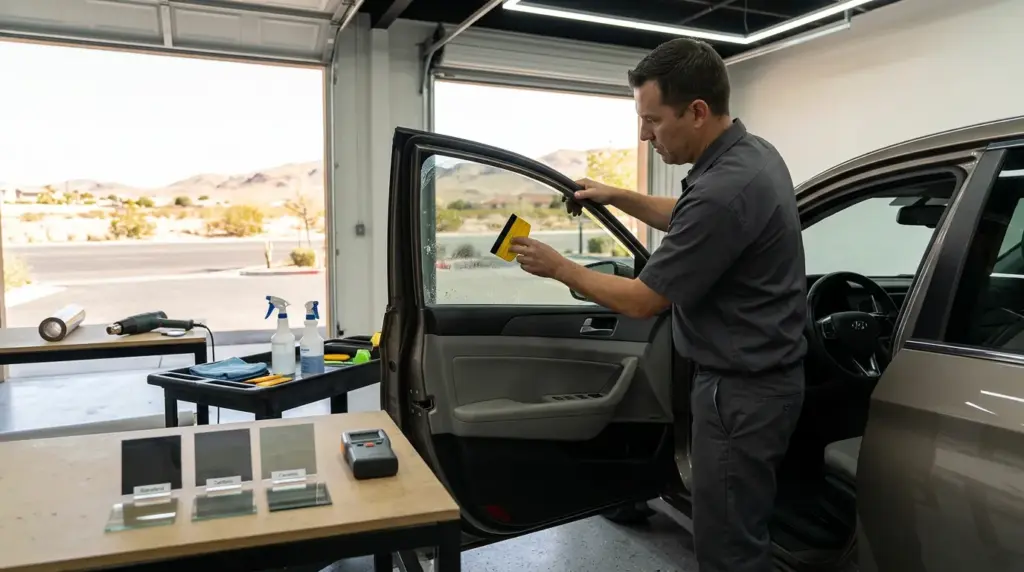
That combination of sunshine and heat is one reason local vehicle owners look into automotive window film.
Hot Cabins After Outdoor Parking
Imagine leaving your truck in an uncovered parking area during a summer afternoon.
When you return, the steering wheel feels hot, the seats are uncomfortable, and the air conditioning needs time to cool the interior.
Sunlight enters through the windows and warms the dashboard, seats, console, and other surfaces.
Those materials absorb solar energy and release heat into the cabin.
Window film can reduce some of the incoming solar energy through the glass it covers.
It won’t keep a parked vehicle cold, but suitable film can help reduce the amount of solar heat entering through treated windows.
Glare During Everyday Travel
Glare can be uncomfortable when sunlight enters directly through the side windows.
The angle of the sun changes throughout the day, so a window that feels comfortable in the morning may receive strong sunlight later.
Tint can reduce the amount of visible light entering the cabin.
Choosing the correct shade matters because reducing too much light can also affect visibility, especially at night.
UV Exposure and Interior Materials
Over time, sunlight can contribute to fading and deterioration of certain interior materials.
Many automotive window films are designed to reject a high percentage of ultraviolet radiation.
UV rejection can help reduce exposure through the treated glass, although actual performance varies by film.
Window tint is one way to help care for your vehicle’s interior, along with regular cleaning and sensible parking habits.
How Does Automotive Window Tint Work?
Window tint is a thin film applied to suitable automotive glass.
Depending on the product, it can reduce visible light, reject portions of incoming solar energy, and provide UV protection.
Different films accomplish these goals using different materials and construction methods.
How Does Window Film Reduce Heat?
Sunlight contains visible, ultraviolet, and infrared energy.
When sunlight reaches a vehicle window, some energy passes through the glass, some is reflected, and some is absorbed.
Solar-control films change how that energy interacts with the treated glass.
Some films absorb portions of the incoming radiation. Others reflect portions away from the vehicle.
The amount of heat entering the cabin depends on the combined glass and film, not the film alone.
Is Window Tint Darkness the Same as Heat Rejection?
No.
A dark film can reduce visible light without necessarily offering the strongest total solar heat rejection.
A lighter ceramic film may reject more solar energy than a darker film with different construction.
That’s why comparing technical specifications is more useful than judging a film by appearance alone.
The 3M Automotive Window Film Support Guide explains the difference between visible light transmission, total solar energy rejection, and infrared rejection.
These measurements help vehicle owners understand what they’re selecting.
Carbon Window Tint Near Nellis Air Force Base, NV
Carbon window tint is one of the options available at Dipped Auto Works.
Carbon-based films use carbon-containing materials to achieve their appearance and solar-control properties.
They are commonly selected by owners who want a darker window appearance, less glare, and protection against some UV exposure.
Benefits of Carbon Window Tint
Depending on the product, carbon tint can provide:
- Reduced visible sunlight
- A darker, more private appearance
- UV rejection
- Some solar heat rejection
- Reduced glare through treated windows
- A consistent window appearance
Carbon film may appeal to owners who care about both comfort and appearance.
Is Carbon Tint Good for Trucks?
Yes, suitable carbon films can be installed on many trucks.
Pickup owners may want front side windows that complement factory-darkened rear glass.
Others may want to treat more eligible windows with the same type of film.
Ask your installer to compare the finished appearance with the vehicle’s existing glass.
Can Carbon Tint Reduce Cabin Heat?
Yes, carbon films can reject some solar energy.
The actual amount depends on the specific film series and glass.
Carbon tint should not be treated as identical to ceramic tint. The products may have different heat-rejection ratings.
Before choosing, ask for the manufacturer’s specifications.
You can learn about our available carbon window tint packages and discuss which option fits your vehicle.
Ceramic Window Tint Near Nellis Air Force Base, NV
Ceramic window tint is another option for owners interested in cabin comfort.
Many ceramic films use nonmetallic materials designed to manage solar radiation while maintaining a clear view through the glass.
Certain products offer strong infrared heat rejection without requiring an extremely dark tint.
This makes ceramic film worth comparing if heat reduction is your main concern.
How Does Ceramic Window Tint Reduce Heat?
Ceramic window films can absorb or reject portions of incoming infrared radiation and other solar energy.
The amount depends on the film’s formulation and shade.
Some ceramic products maintain high visible light transmission while still providing useful solar heat rejection.
That means you may be able to choose a lighter shade without giving up as much heat-rejection performance as you might expect.
Does Ceramic Tint Block UV Rays?
Many ceramic window films reject a high percentage of UV radiation.
Some products advertise UV rejection of 99% or more under their tested conditions.
That doesn’t mean every ceramic film performs identically.
Ask your installer for the UV rejection rating of the actual product being installed.
Is Ceramic Tint Better for Hot Weather?
Ceramic film is worth considering in hot climates because many products are designed with heat rejection as a major feature.
But a ceramic label alone doesn’t guarantee the best performance.
Compare Total Solar Energy Rejection (TSER), film clarity, visible light transmission, and warranty information.
At Dipped Auto Works, we offer ceramic window tint services and can explain the available film choices for your vehicle.
Carbon vs Ceramic Window Tint: Which Film Makes More Sense?
If you’re searching for window tint near Nellis Air Force Base, NV, carbon and ceramic films are two options worth comparing.
Both can improve the appearance of eligible vehicle windows and reduce some sunlight entering the interior.
Their measured performance may differ.
| Feature | Carbon Window Tint | Ceramic Window Tint |
|---|---|---|
| Reduces visible sunlight | Yes, depending on shade | Yes, depending on shade |
| Solar heat rejection | Depends on product | Depends on product, with high-performance options |
| UV protection | Available | Available |
| Multiple tint shades | Yes | Yes |
| Privacy | Depends on shade | Depends on shade |
| Glare reduction | Yes | Yes |
| Lighter-appearing heat-control options | Product-dependent | Available in many ceramic product lines |
| Nevada legal requirements | Apply | Apply |
| Professional installation | Recommended | Recommended |
Choose Carbon Tint When Appearance Is a Major Concern
Carbon tint may make sense if you want a uniform dark appearance, reduced glare, and suitable UV protection.
Your installer can show you samples and explain available shades.
Choose Ceramic Tint When Heat Rejection Is Your Main Concern
Ceramic tint deserves consideration if you want to reduce incoming solar energy while preserving an appropriate level of visible light.
Be sure to compare technical ratings rather than assuming every ceramic product performs the same.
What About Factory Privacy Glass?
Some SUVs and trucks already have darkened rear windows.
That doesn’t necessarily mean the glass has the same heat-rejection properties as a high-performance aftermarket film.
Ask your installer to evaluate the existing glazing before recommending another layer.
The finished light transmission and film compatibility matter.
Understanding Window Tint Heat Rejection Ratings
A tint consultation should include more than a shade sample.
Manufacturers publish measurements that describe how their films affect light and solar energy.
Here are four ratings worth knowing.
Visible Light Transmission (VLT)
VLT measures how much visible light passes through the glass and film.
A higher VLT means more visible light passes through.
A lower VLT generally means a darker appearance.
This measurement matters for nighttime visibility and Nevada tint requirements.
Total Solar Energy Rejection (TSER)
TSER measures the percentage of total solar energy rejected by the filmed glass.
It accounts for more than just visible light.
When comparing heat-rejecting films under similar test conditions, this is one of the most useful ratings.
Infrared Rejection (IRR)
IRR measures infrared energy rejection over a specified wavelength range.
The advertised percentage can depend on the measurement range used.
A product showing a high infrared rejection number does not necessarily reject the same percentage of all solar heat.
Ultraviolet Rejection
UV rejection describes how much ultraviolet radiation the treated glass blocks.
This can matter for occupants and interior materials.
It is separate from total heat-rejection performance.
The 3M Automotive Film Terminology Guide provides definitions for these measurements, including Infrared Energy Rejection (IRER).
Here’s what matters: Ask for performance data on the exact film you are considering, and compare the ratings under similar test conditions.
Nevada Window Tint Laws for Nellis Air Force Base Area Vehicles
Before installing window tint, it’s necessary to understand Nevada’s rules.
The relevant state law is Nevada Revised Statutes NRS 484D.440.
The law addresses window film on vehicles required to be registered in Nevada and contains different conditions for front side windows, rear windows, and windshields.
Front Side Window Tint
Nevada permits nonreflective tint on windows immediately beside the driver when the combined film-and-glass light transmission is at least 35%, with the 7% tolerance stated in the law.
This refers to the completed window, not only the film.
For that reason, selecting a film marked 35% VLT does not automatically establish that the finished glass meets the requirement.
Ask your installer to evaluate the combined result.
Rear Side Window Tint
Nevada allows tint on side windows behind the driver under the conditions stated in NRS 484D.440.
The vehicle must have outside mirrors on both sides that provide the required rearward view.
The law does not impose the same front-side-window VLT threshold on eligible rear side windows.
Visibility and suitable film selection still matter.
Rear Window Tint
Rear window tint is permitted under the statutory mirror conditions.
Some vehicles have large rear windows with defroster lines, cameras, or other features that require careful installation.
Ask the shop to inspect those surfaces before selecting a film.
Front Windshield Tint
Nevada generally restricts aftermarket material across the windshield when that material changes its color or reduces light transmission, unless an applicable exception exists.
The statute allows certain tint on the topmost portion of the windshield, subject to its placement and color restrictions.
A nearly clear ceramic film does not automatically qualify for full-windshield installation.
Dipped Auto Works publishes windshield and ceramic glare strip options, but any proposed installation must be evaluated under the applicable legal requirements.
What If Your Vehicle Has Out-of-State Registration?
This question may matter for military personnel and other vehicle owners near Nellis Air Force Base, NV.
NRS 484D.440 is written around vehicles required to be registered in Nevada.
If your vehicle is registered in another state, do not assume that Nevada’s ordinary tint limits, an exemption, or a different state’s rules apply to you in every situation.
Check with the appropriate registration and enforcement authorities.
If you regularly enter Nellis Air Force Base, NV, ask the installation’s security office about any access-related vehicle requirements.
Dipped Auto Works is an independent automotive shop, not an on-base tint facility.
Choosing Which Windows to Tint
The film type is only one part of the decision.
You also need to choose which windows will receive film.
At Dipped Auto Works, our published packages include two-front-window, all-side-window, and full-tint options in carbon and ceramic film.
The exact glass coverage of any package should be confirmed before installation.
Two Front Window Tint
This option focuses on the windows beside the front seats.
It can be useful when the rear windows already have factory-darkened glass.
For trucks and SUVs, front tint is sometimes chosen to create a more consistent appearance between the front and rear side windows.
Remember that the front windows must meet Nevada’s light transmission requirements.
All Side Window Tint
This option treats eligible side windows along the vehicle.
It may be worth considering if passengers regularly sit in the rear seats or if sunlight enters through both sides throughout the day.
Ask whether the package includes small quarter windows or other fixed glass sections.
Full Window Tint Packages
A full tint package generally covers a wider selection of eligible side and rear windows.
However, don’t assume the package includes the windshield, glass roof, or every small window.
Ask for a written list of included glass areas.
Ceramic Glare Strips
A legally suitable upper-windshield strip may help reduce some glare coming through the top of the windshield.
Nevada restricts its placement and color.
An installer should check the vehicle and applicable law before fitting the strip.
Window Tint Options for Trucks, SUVs, Teslas, and Sedans
Window tint near Nellis Air Force Base, NV, can be suitable for many types of vehicles.
Your selection should account for the number of windows, factory glazing, and how you use the interior.
Pickup Trucks
Pickup owners may want to match the appearance of front side windows with darker rear glass.
Others may be more concerned about afternoon heat reaching the front seats.
Carbon and ceramic film can both be considered.
The best choice depends on the desired appearance and tested heat-rejection properties.
Family SUVs
SUVs often have larger glass areas and multiple seating rows.
Rear passengers may receive direct sunlight through side windows during travel.
Suitable ceramic film across eligible windows may help reduce incoming solar energy.
If your SUV already has privacy glass, ask how the proposed film will perform when combined with the existing glass.
Tesla Model 3 and Model Y
Tesla vehicles have distinctive window and glass-roof layouts.
Their factory glass may already include solar-control properties.
If you own a Tesla, the installer should consider the model year, existing glass construction, rear-window shape, and any roof-glass compatibility concerns.
Dipped Auto Works offers dedicated Tesla window tint services for owners interested in carbon and ceramic film.
Luxury and Performance Vehicles
BMW, Mercedes-Benz, Audi, Porsche, and other specialty vehicles may have curved glass, frameless windows, and interior components that need careful handling during installation.
Ask how the shop protects interior trim and electronic components.
The selected film should also suit your preferred appearance and visibility needs.
What Window Tint Can and Cannot Do for Your Vehicle
Window tint has practical benefits, but it helps to understand what the product cannot guarantee.
Benefits of Quality Automotive Window Film
Depending on the film, benefits may include:
- Reduced solar energy entering through treated glass
- Less visible glare
- UV rejection
- A darker window appearance
- More privacy during daylight
- Less exposure of interior materials to sunlight
- Improved comfort during sunny travel
Window Tint Will Not Keep a Parked Vehicle Cold
Even a vehicle with heat-rejecting film can become dangerously hot when parked in the sun.
Window film does not replace air conditioning, ventilation, or shaded parking.
The Centers for Disease Control and Prevention warns that parked vehicles can heat up quickly, even when the windows are cracked.
Never leave children or pets unattended in a parked vehicle.
Window Tint Does Not Guarantee Privacy
A darker window can make it harder to see inside under certain lighting conditions.
It does not make a vehicle completely private.
People may still see through tinted glass depending on the light, viewing angle, and film shade.
Don’t leave valuables visible in a parked vehicle simply because the windows are tinted.
Window Tint Does Not Prevent Every Interior Problem
Automotive film may reduce UV exposure and some incoming heat.
It cannot prevent all aging, staining, cracking, or wear affecting the interior.
Routine auto detailing and proper interior care remain useful.
What to Expect During Professional Window Tint Installation
A professional window tint service involves several steps.
The exact process depends on the vehicle, the film, and the number of windows being treated.
Step 1: Vehicle and Glass Inspection
The installer checks the vehicle’s glass for existing tint, scratches, chips, residue, and other concerns.
Any factory privacy glass should be discussed.
The technician should also review the legal limits for the windows you want treated.
Step 2: Film and Shade Selection
You’ll compare the available carbon and ceramic film options.
Ask about visible light transmission, heat-rejection ratings, and warranty coverage.
If you want a particular appearance, request samples.
Step 3: Glass Preparation
The glass needs thorough cleaning before installation.
Dust and debris trapped beneath the film can affect the finished appearance.
The technician should also take care around interior trim, window switches, electronics, and defroster components.
Step 4: Film Installation
The window film is fitted to the glass and applied using the appropriate installation procedure.
Curved glass may require additional shaping.
A clean installation should have carefully finished edges and an appearance consistent with the selected product.
Step 5: Final Inspection and Care Instructions
At pickup, ask the installer to show you the treated windows.
Freshly installed tint may show temporary moisture patterns during drying.
Your installer should explain what’s normal, when you can lower the windows, and when cleaning is permitted.
If any issue remains after the recommended curing period, contact the shop.
How to Maintain Window Tint in the Northeast Valley
Once your tint is installed, appropriate care helps preserve its appearance.
Film manufacturers may have different cleaning instructions, so follow the guidance supplied with your installation.
Wait Before Lowering the Windows
Fresh tint needs time to dry.
Lowering the windows too soon may disturb the film edges.
Ask your installer for the waiting period that applies to your film.
Use Tint-Safe Cleaning Products
Choose a cleaner approved for automotive window film.
Dipped Auto Works recommends soft cleaning cloths and ammonia-free cleaning solutions for its tint products.
Avoid abrasive pads, razor blades, and aggressive scraping.
Clean the Film Gently
Use a clean microfiber towel and light pressure.
If dirt or residue doesn’t come off easily, ask the installer about a suitable cleaning method rather than using harsh chemicals.
Check for Film Damage
Inspect the windows occasionally for:
- Peeling edges
- Persistent bubbles
- Scratches
- Film separation
- Changes in color
- Cloudiness that remains after curing
Don’t attempt to peel or trim damaged film yourself.
Contact the shop to discuss inspection or warranty support.
Choosing a Window Tint Shop Near Nellis Air Force Base, NV
When comparing window tint shops, look beyond the appearance of a recently finished vehicle.
Ask about product information, installation methods, warranty coverage, and legal compliance.
Questions Worth Asking Before Booking
- What film manufacturer and product series do you use?
- Do you offer both carbon and ceramic tint?
- What are the TSER and VLT ratings?
- Which windows are included?
- Will the finished front side windows meet Nevada requirements?
- Does the vehicle need existing tint removed?
- What preparation work is included?
- What is the expected installation schedule?
- What warranty comes with the film?
- Will I receive aftercare instructions?
A useful consultation should leave you knowing what will be installed and why it suits your vehicle.
Why Consider Dipped Auto Works?
Dipped Auto Works is a certified vehicle customization and protection shop located in Las Vegas, NV.
We serve vehicle owners from communities across the valley, including those near Nellis Air Force Base, NV, North Las Vegas, NV, and Sunrise Manor, NV.
Our window tint services include carbon and ceramic packages, multiple shade options, and warranty-backed installation.
Our published tint packages list lifetime warranty coverage. The exact terms, exclusions, and requirements should be confirmed for the film and service selected.
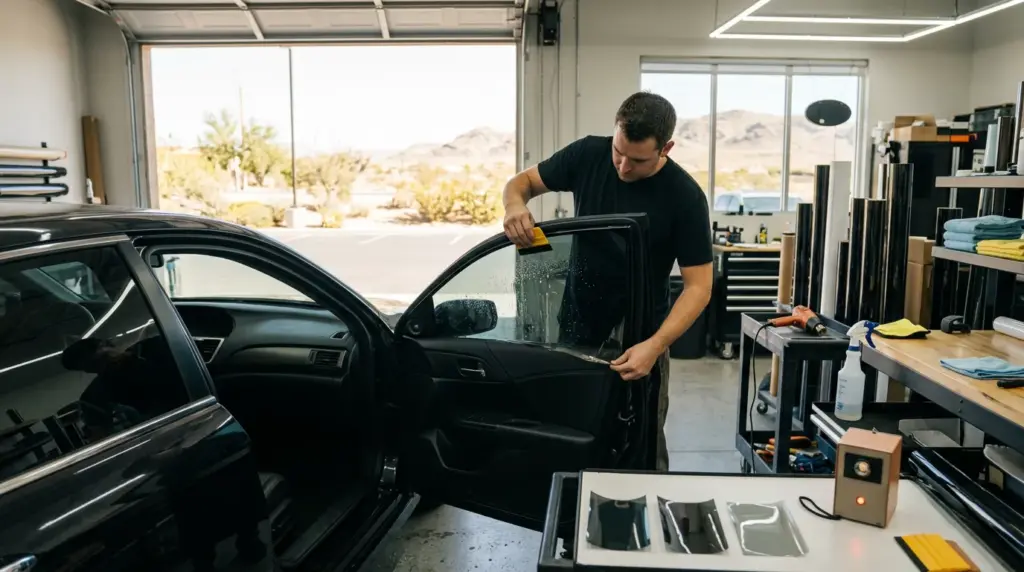
Whether you want tint for a pickup, family SUV, Tesla, or luxury vehicle, our team can help you compare options and discuss suitable coverage.
Window Tint Near Nellis Air Force Base, NV: 7 Frequently Asked Questions
1. Is ceramic window tint worth it near Nellis Air Force Base, NV?
Ceramic window tint is worth considering if reducing solar heat entering your vehicle is a major concern.
Many ceramic films are designed to reject infrared energy while maintaining appropriate visibility.
The actual performance depends on the film and glass.
Ask for the manufacturer’s TSER and VLT ratings before choosing a shade.
2. What is the difference between carbon and ceramic tint?
Carbon tint can provide a darker appearance, glare reduction, UV protection, and some heat rejection.
Ceramic tint uses different materials and may offer stronger heat-rejection performance at certain shades.
Neither label alone tells you how well a specific film performs.
Compare the actual product specifications.
3. What is the legal front window tint in Nevada?
Nevada Revised Statutes NRS 484D.440 permits nonreflective tint on the windows immediately beside the driver when combined glass-and-film light transmission is at least 35%, subject to the law’s 7% tolerance.
The finished window must meet the requirement.
Ask your installer to review the applicable law and glass measurements.
4. Can military personnel use darker window tint in Nevada?
Military status alone should not be assumed to create a special window tint exemption.
Vehicle registration, applicable Nevada law, and any valid exemption can affect what rules apply.
Personnel with vehicles registered outside Nevada should verify their situation with the appropriate authorities.
If the vehicle regularly enters Nellis Air Force Base, NV, confirm any relevant installation access rules separately.
5. Will window tint keep my truck or SUV cooler when parked?
Heat-rejecting film can reduce part of the solar energy passing through treated windows.
It cannot prevent a parked vehicle from becoming hot during summer.
Covered parking and a removable windshield sunshade can also help reduce direct sunlight entering the cabin.
Never leave children or pets unattended in a parked vehicle.
6. How long does professional automotive window tint last?
Window tint lifespan depends on the product, installation, exposure, and cleaning habits.
Quality automotive films may last for years when properly maintained.
Dipped Auto Works offers warranty-backed window tint packages, with lifetime warranty terms listed for its published carbon and ceramic options.
Review the written coverage for your selected product.
7. Where can I schedule window tint near Nellis Air Force Base, NV?
You can schedule window tinting with Dipped Auto Works, located at 4305 Dean Martin Dr #120, Las Vegas, NV 89103.
Our shop serves vehicle owners throughout the Las Vegas area, including those coming from near Nellis Air Force Base, NV.
We provide carbon and ceramic tint options for eligible vehicle windows.
Call (702) 379-8716 or visit our contact page to request an appointment.
Schedule Window Tint Near Nellis Air Force Base, NV, With Dipped Auto Works
Choosing the right window tint starts with understanding what matters most to you.
If you want a darker appearance and reduced glare, carbon window film may be worth considering.
If reducing incoming solar heat is a bigger concern, compare the ceramic film options and their tested heat-rejection ratings.
The best setup also depends on the number of windows, factory glass, local legal requirements, and how you use your vehicle.
At Dipped Auto Works, we help vehicle owners near Nellis Air Force Base, NV, review the available window tint options before scheduling installation.
Our certified team offers:
- Carbon Window Tint
- Ceramic Window Tint
- Front Side Window Tint
- All Side Window Tint
- Full Window Tint Packages for Eligible Glass
- Legally Suitable Glare Strip Options
- Tesla Window Tint
- Warranty-Backed Tint Installation
We can explain the differences between carbon and ceramic film, discuss Nevada’s tint rules, and review the coverage suitable for your vehicle.
Contact Dipped Auto Works
Business Name: Dipped Auto Works
Address: 4305 Dean Martin Dr #120, Las Vegas, NV 89103
Phone: (702) 379-8716
Business Hours: Monday through Saturday, 9 AM to 6 PM
Website: www.dippedautoworks.com
Schedule an Appointment: Contact Dipped Auto Works
Ready to make your vehicle more comfortable during sunny days?
Call (702) 379-8716 or fill out our contact form to request a window tint consultation.
Tell us your vehicle’s year, make, and model, along with whether you’re interested in carbon or ceramic film.
Our team will help you compare available options, review window coverage, and select a suitable, lawful tint installation for your vehicle.
Sources and References
The following sources support the information about window tint laws, film performance, local climate, geographic location, parked-vehicle safety, and Dipped Auto Works services.
1. NRS 484D.440: Restrictions on Tinting of Windshield or Side or Rear Window
- Publisher: Nevada Legislature
- Publication Date: 2025 statutory edition, online compilation revised April 15, 2026
- URL: https://www.leg.state.nv.us/NRS/NRS-484D.html#NRS484DSec440
2. Auto Films: Official 3M Support and Window Film Terminology
- Publisher: 3M
- Publication Date: Not listed
- URL: https://www.3m.com/3M/en_US/car-personalization-us/support/
3. Nellis Air Force Base Fact Sheet
- Publisher: United States Air Force, Nellis Air Force Base
- Publication Date: Not listed
- URL: https://www.nellis.af.mil/About/Fact-Sheets/Display/Article/284174/nellis-air-force-base/
4. Las Vegas 1991-2020 Climate Normals
- Publisher: National Weather Service, NOAA
- Publication Date: 2021 climate normals release; webpage publication date not listed
- URL: https://www.weather.gov/vef/1991-2020Normals
5. Infants and Children and Heat
- Publisher: Centers for Disease Control and Prevention
- Publication Date: June 25, 2024
- URL: https://www.cdc.gov/heat-health/risk-factors/infants-and-children.html
6. Automotive Window Tint
- Publisher: Dipped Auto Works
- Publication Date: Not listed
- URL: https://dippedautoworks.com/services/window-tint/
7. Window Tint Packages and Film Information
- Publisher: Dipped Auto Works
- Publication Date: Not listed
- URL: https://dippedautoworks.com/deals/window-tint-deals/
8. Tesla Window Tint
- Publisher: Dipped Auto Works
- Publication Date: Not listed
- URL: https://dippedautoworks.com/tesla-services/tesla-window-tint/
9. Auto Detailing
- Publisher: Dipped Auto Works
- Publication Date: Not listed
- URL: https://dippedautoworks.com/services/auto-detailing/
Best Color Change Wraps in Las Vegas, NV: A Comprehensive Guide
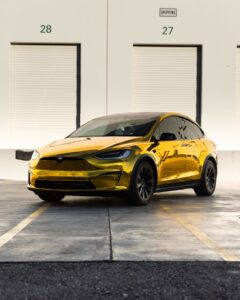
Discover the best color change wraps in Las Vegas, NV, with Dipped Auto Works. From choosing the perfect color to expert installation, learn how to transform your car with a vinyl wrap that suits your style and protects your vehicle. Call (702) 379-8716 to schedule your consultation today!
Product Brand: Dipped Auto Works
5
Pros
- Discover the best color change wraps in Las Vegas, NV, with Dipped Auto Works. From choosing the perfect color to expert installation, learn how to transform your car with a vinyl wrap that suits your style and protects your vehicle. Call (702) 379-8716 to schedule your consultation today!
