
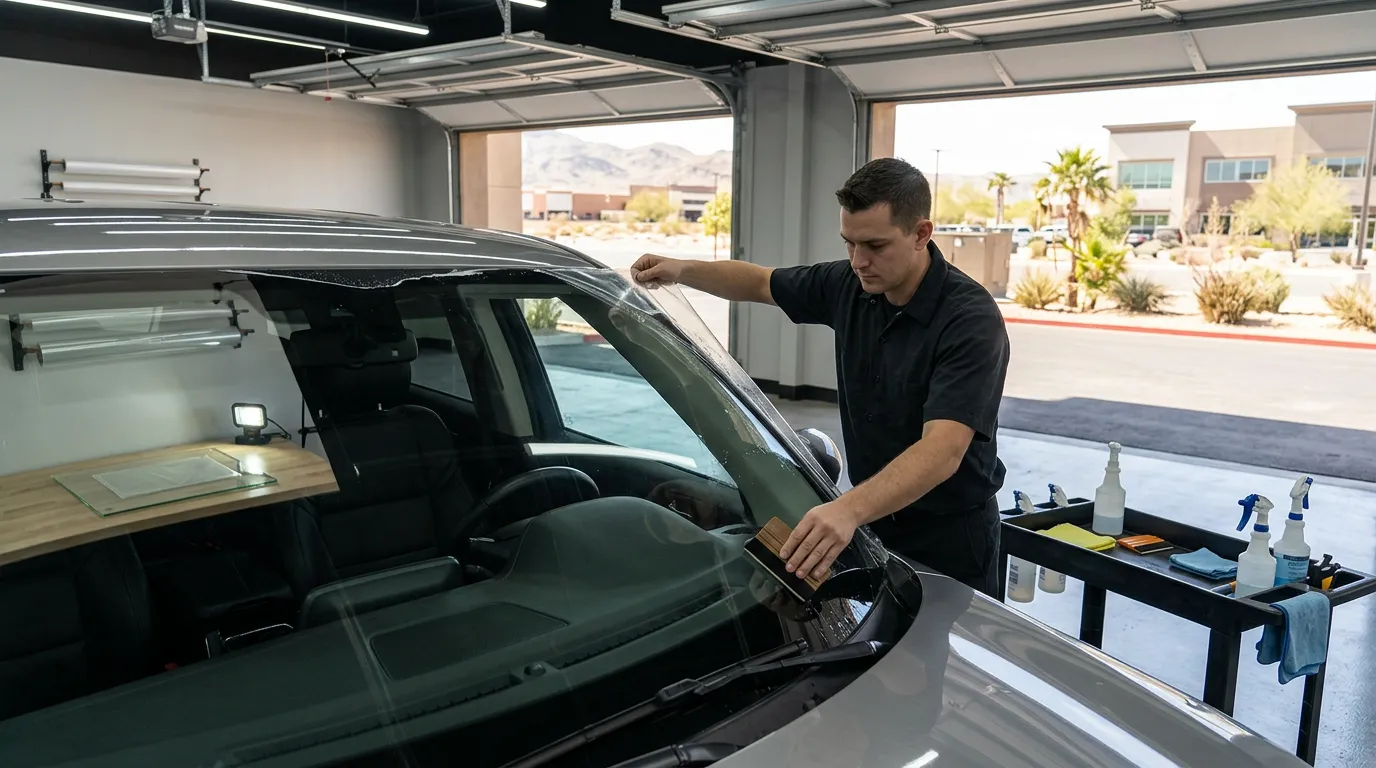
Windshield protection film in Las Vegas, NV, can be worth considering if you’re tired of hearing rocks strike your windshield on the highway. A single piece of road debris can leave a chip, create a spreading crack, or turn an ordinary commute into an unexpected glass repair. For owners who spend plenty of time on the road, adding a protective layer to the windshield may help reduce the risk of certain impacts damaging the glass.
But is windshield protection film actually worth it?
The answer depends on your vehicle, how often you encounter road debris, and what you expect the film to accomplish.
A properly selected windshield protection film is designed to absorb some of the impact from small stones and debris before they strike the glass directly. It can help reduce the likelihood of chips and cracks, but it cannot stop every impact. The film also wears over time and may eventually need replacement.
There are other considerations for Las Vegas vehicle owners. Windshield clarity, windshield wiper performance, cameras, Nevada’s windshield laws, and product warranties all matter before installation.
At Dipped Auto Works, we offer professional windshield protection film installation in Las Vegas, NV. Our XPEL-certified team helps customers understand the film’s protective features, maintenance needs, and installation requirements.
Here’s what you should know before deciding whether windshield protection film makes sense for your vehicle.
Table of Contents
- What Is Windshield Protection Film?
- How Windshield Protection Film Works
- Why Las Vegas Vehicle Owners Consider Windshield Film
- Is Windshield Protection Film Worth It?
- What Windshield Protection Film Cannot Prevent
- Windshield Protection Film vs Window Tint and Ceramic Coating
- Does Windshield Protection Film Affect Visibility?
- Nevada Laws and Windshield Protection Film
- How Long Does Windshield Protection Film Last?
- How to Maintain Windshield Protection Film
- Windshield Cameras, Sensors, and Vehicle Compatibility
- What to Expect During Professional Installation
- Insurance, Warranty, and Film Replacement
- How to Decide Whether Windshield Film Fits Your Needs
- Windshield Protection Film FAQs
- Contact Dipped Auto Works in Las Vegas, NV
- Sources and References
What Is Windshield Protection Film?
Windshield protection film is a transparent protective material applied to the exterior surface of suitable automotive windshields.
Unlike ordinary window tint, which is mainly designed to manage light and solar heat, windshield protection film is made to help protect glass from physical damage caused by road debris.
Think of it as a replaceable protective layer between the windshield and the outside environment.
When a small stone strikes the covered surface, the film can absorb or distribute some of that impact energy.
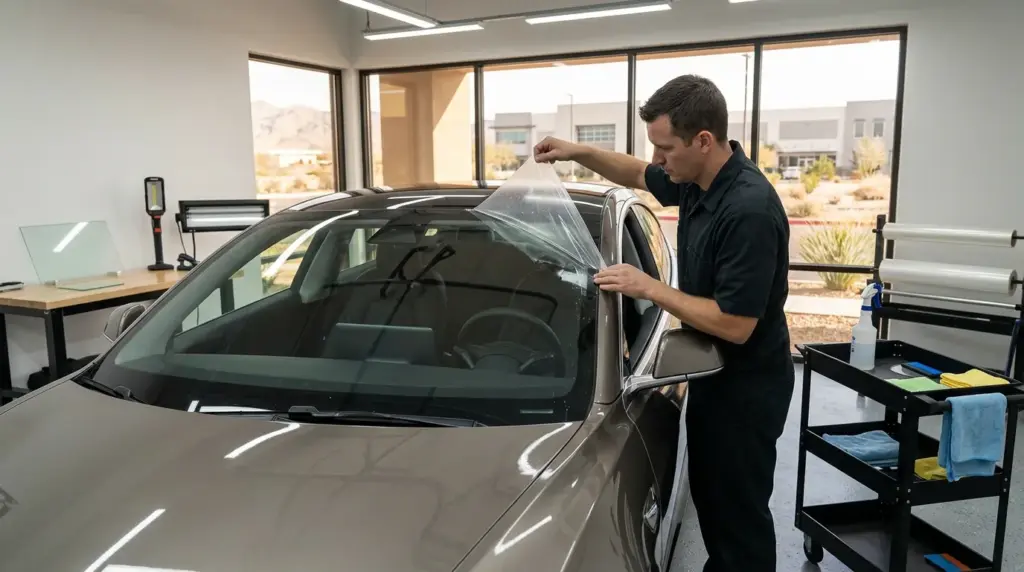
The goal is to reduce the chance that the impact creates a chip or crack in the glass underneath.
Is Windshield Protection Film the Same as Paint Protection Film?
The two products have similar goals, but they’re designed for different surfaces.
Paint protection film is made for suitable painted body panels.
Windshield protection film is made for automotive glass, where optical clarity and windshield wiper contact are major concerns.
You should not apply ordinary body-panel PPF to a windshield simply because both products are transparent.
A windshield needs film designed and approved for that application.
What Is Windshield Protection Film Made From?
Manufacturers use different materials and coatings.
For instance, XPEL offers a windshield protection film based on a transparent protective film construction.
Madico’s ClearPlex Contour uses a PET-based film with a scratch-resistant surface coating.
Both are intended to help reduce windshield damage from road debris, but their material specifications, care instructions, and warranty terms differ.
You can review the products directly through XPEL Windshield Protection Film and Madico ClearPlex.
At Dipped Auto Works, our published windshield protection service features XPEL film.
How Does Windshield Protection Film Prevent Rock Chips?
A windshield is made from safety glazing designed for automotive use.
It can withstand normal operating conditions, but a sharp stone impact may still damage the outer glass surface.
Windshield protection film adds a sacrificial layer over the glass.
That means the protective material is intended to take some of the wear and damage that might otherwise reach the windshield.
What Happens When a Rock Hits the Film?
The result depends on the stone’s size, shape, speed, and impact angle.
For certain smaller impacts, the film may absorb enough energy to prevent or reduce damage to the glass.
For stronger impacts, the film may become marked, cut, or punctured.
The windshield beneath it can still crack.
XPEL describes its product as a protective barrier that helps reduce damage from rocks and roadway debris.
The manufacturer also states that the film itself may show wear because it acts as the sacrificial surface.
Does the Film Make a Windshield Unbreakable?
No.
No automotive windshield protection film should be treated as break-proof glass.
A sharp, high-energy impact can still damage the windshield even when a protective film is installed.
The film is intended to reduce certain risks, not eliminate them.
Can Windshield Film Stop an Existing Crack From Spreading?
You shouldn’t rely on it for that purpose.
Windshield protection film is a preventive treatment, not a structural glass repair.
A crack that has already formed needs to be evaluated by a qualified auto glass professional.
If your windshield has a chip or crack, address that condition before scheduling film installation.
Why Windshield Protection Film in Las Vegas, NV, Gets Attention
Las Vegas motorists have plenty of reasons to think about protecting their vehicle’s exterior.
Local roads, highway traffic, outdoor parking, and regular trips around Southern Nevada can expose vehicles to debris and dust.
The National Weather Service’s 1991-2020 Climate Normals document the region’s hot, dry climate.
Those conditions make proper exterior care a regular concern, although climate alone does not establish how often a windshield will suffer a rock strike.
Rocks and Debris on the Highway
Small stones can be thrown into the air by moving tires.
This may happen around construction activity, loose gravel, or debris already present on the roadway.
If a stone reaches your windshield, damage can occur before you have time to react.
A protective film may help reduce the effects of certain impacts.
Frequent Highway Travel
Vehicle owners who spend long periods on highways may have more opportunities to encounter flying debris than people who rarely use their cars.
That doesn’t mean every highway trip creates a high risk.
It does mean your travel habits are worth considering when deciding whether windshield film makes sense.
Protecting Newer Vehicles
Modern vehicles may have forward-facing cameras, rain sensors, heating elements, acoustic glass, or other windshield-related equipment.
Replacing the windshield can involve more than installing a piece of glass.
For some vehicles, additional inspections and camera calibration may be required.
Keeping the existing windshield intact may help avoid those procedures.
The film itself, though, must not interfere with any of those systems.
Luxury and Performance Cars
Owners of specialty vehicles may place extra importance on maintaining their factory windshield.
Some models use vehicle-specific glazing, shapes, coatings, or sensor arrangements.
Windshield protection film may be worth discussing when the original glass is in good condition and a suitable, lawful product is available.
Is Windshield Protection Film Worth It in Las Vegas?
For some owners, yes.
Windshield protection film can be worth considering when the goal is to reduce exposure to certain rock chips and preserve an undamaged windshield.
But that value depends on the vehicle, the film’s real-world performance, installation suitability, and maintenance requirements.
When Windshield Film May Be a Good Fit
It may be worth evaluating if:
- You frequently travel on highways.
- You’ve experienced repeated windshield chips.
- Your vehicle has expensive or specialized windshield equipment.
- You want to preserve your original windshield.
- You understand the film may need replacement.
- You’re comfortable following the manufacturer’s cleaning instructions.
- The product is compatible with your vehicle and meets applicable legal requirements.
When Windshield Film May Not Be the Right Choice
It may be less appealing if:
- Your windshield already has damage requiring repair.
- You expect complete protection against every rock strike.
- You don’t want additional wiper and film maintenance.
- You’re sensitive to even minor optical changes.
- The vehicle manufacturer does not approve the proposed application.
- The film’s compliance with Nevada rules cannot be established.
Is It Worth It Only for Expensive Vehicles?
No.
A protective layer may be useful for a regularly used sedan, SUV, truck, or electric vehicle.
But the decision should reflect the vehicle’s windshield, usage, and owner preferences rather than the badge on the hood.
A practical approach is to ask what kind of windshield damage you’re trying to prevent and whether the chosen film is designed to address that risk.
What Windshield Protection Film Cannot Prevent
A windshield film consultation should include an explanation of its limitations.
The product can help, but it isn’t a substitute for appropriate glass repair, safe vehicle operation, or regular maintenance.
Severe Rock Impacts
A large stone or sharp object can strike with more force than the film can absorb.
Even if the film reduces some of the impact, the windshield may still chip or crack.
Cracks Caused by Existing Glass Damage
Windshield film doesn’t repair structural weakness already present in the glass.
An existing chip or crack should be assessed before applying a film.
Every Type of Surface Scratch
Windshield protection film can develop scratches.
XPEL advises that its windshield film may be scratched by contaminated or worn wiper blades.
That is one reason it recommends installing new wiper blades with the film.
Damage Outside the Covered Area
The film only protects the surface it actually covers.
Any uncovered edges or sections do not receive that protective layer.
The Need for Future Glass Replacement
A windshield may eventually require replacement because of impact damage, defects, or other conditions.
Film cannot guarantee that the original glass will last for the lifetime of the vehicle.
Windshield Protection Film vs Tint, Ceramic Coating, and Body PPF
These services are sometimes discussed together, but they address different concerns.
Windshield Protection Film
Its main purpose is to reduce the risk of certain chips, cracks, and surface damage from road debris.
It is designed for use on compatible windshield glass, subject to applicable laws and manufacturer restrictions.
Automotive Window Tint
Automotive window tint is mainly used to reduce visible light, glare, UV exposure, or solar heat, depending on the product.
It is not designed to provide the same impact protection as windshield protection film.
Nevada also places specific restrictions on aftermarket windshield tint and other transparent films.
Ceramic Glass Coating
A suitable glass coating may provide water repellency and make some contamination easier to remove.
It is not designed to absorb stone impacts in the same way as a protective film.
XPEL distinguishes its windshield protection film from ceramic coatings on its official product page.
Paint Protection Film
Paint protection film for vehicles is used on painted surfaces such as the hood, bumper, and fenders.
Its construction and intended use differ from products made for windshield glass.
Windshield Protection Comparison
| Product | Main Purpose | Rock Chip Protection |
|---|---|---|
| Windshield protection film | Reduce certain impacts on glass | Designed for this purpose |
| Automotive window tint | Light and solar control | Not its intended purpose |
| Ceramic glass coating | Water repellency and easier cleaning | Not designed for substantial impact absorption |
| Body paint protection film | Protect suitable painted panels | Yes, on approved body surfaces |
If windshield chips are your main concern, ask about windshield protection film rather than assuming tint or a glass coating provides the same benefit.
Does Windshield Protection Film Affect Visibility?
A windshield film must allow you to see the road clearly.
That is a major difference between applying a protective film to body paint and applying one directly in the line of sight.
Manufacturers design windshield films for optical clarity, but real-world results can depend on the product, installation, and its condition over time.
Is Windshield Protection Film Completely Invisible?
It may be difficult to notice when properly installed, but no installer should promise that every person will see absolutely no difference under every lighting condition.
XPEL states that its windshield film is optically clear from inside the vehicle.
Its official FAQ also notes that slight rainbow effects may be visible from outside when using polarized sunglasses.
That is worth knowing if you are sensitive to optical effects.
Can Worn Film Affect Nighttime Visibility?
A film that develops scratches, haze, or other damage may affect how light appears through the windshield.
Headlights, streetlights, and sunlight can make surface defects more noticeable.
If you notice distortion, streaking, or haze that affects your view, contact the installer.
Do not continue using a windshield treatment that interferes with safe visibility.
Why Professional Fitting Matters
Dust, trapped contamination, poor edge finishing, and installation defects may affect the result.
A professional should inspect the windshield before installation and check the finished appearance under appropriate lighting.
If the windshield is already pitted or damaged, the film may not produce the clear appearance you expect.
Is Windshield Protection Film Legal in Las Vegas, NV?
This is one of the most important questions to answer before installation.
Clear windshield protection film should not automatically be assumed legal in Nevada simply because it has no visible tint.
Nevada Revised Statutes NRS 484D.440 generally prohibits applying transparent aftermarket material to a covered vehicle’s windshield if the material changes the color or reduces the windshield’s light transmission, unless an applicable statutory or regulatory exception exists.
That language is broader than simply prohibiting dark tint.
Does Clear Film Reduce Light Transmission?
A film can appear transparent while still changing the amount of visible light passing through a glass assembly.
The exact result depends on the material and existing windshield.
A product described as clear or optically transparent is not automatically exempt from a law addressing light transmission.
The film’s specifications and the completed glass-and-film combination must be reviewed.
What About the Legal Windshield Strip?
Nevada provides a specific exception for material installed on the topmost portion of the windshield when it meets the statute’s placement and color requirements.
That exception is not blanket permission to cover the entire windshield with aftermarket film.
Are There Other Exceptions?
Nevada law and regulations provide certain exceptions and exemption procedures.
The applicable conditions depend on the circumstances.
You should not assume that a medical exemption or another exception applies without the required authorization.
See Nevada Administrative Code Chapter 484D for the relevant regulations.
What Should You Do Before Installing Film?
Before committing to windshield protection film in Las Vegas, NV, ask the installer to explain:
- The exact film manufacturer and product
- Its published visible light transmission specifications
- Whether the completed application is permitted under Nevada law
- Whether the vehicle manufacturer allows the treatment
- Any windshield camera or sensor restrictions
- What documentation supports the proposed installation
If the legal status of a specific full-windshield application is uncertain, seek clarification from the appropriate Nevada authorities before installation.
A shop should not promise legality solely because a film looks clear.
How Long Does Windshield Protection Film Last in Las Vegas, NV?
Windshield protection film is not necessarily a lifetime product.
It is a sacrificial material exposed to sunlight, dust, rain, road debris, washer fluid, and repeated windshield wiper contact.
Its lifespan depends on the film, maintenance, travel conditions, and how much wear it receives.
What Does XPEL Say About Lifespan?
According to XPEL’s windshield protection film information, lifespan varies with environmental conditions and maintenance.
XPEL currently lists a one-year warranty for its windshield protection film.
Its FAQ describes the warranty as one year or 12,000 miles, subject to its written terms.
That is not the same as a promise that the film will fail after one year.
It also does not guarantee the film will last for several years on every vehicle.
Why Do Windshield Films Wear Differently From Body PPF?
The windshield is exposed to moving wiper blades.
That repeated contact can contribute to surface wear, particularly when dust or grit is present.
The film also receives direct contact from road debris.
This is different from protective film applied to a hood or fender.
When Might the Film Need Replacement?
Replacement may be worth discussing when you notice:
- Persistent scratches
- Cloudiness or haze
- Edge lifting
- Peeling
- Bubbles
- Reduced optical clarity
- Physical damage from road debris
- Other wear affecting visibility
Do not wait for severe visual problems before arranging an inspection.
Can the Film Be Replaced Without Replacing the Glass?
Often, yes.
Windshield protection films are intended to be removable and replaceable under suitable conditions.
XPEL describes its windshield film as removable without adhesive residue.
The removal process should follow manufacturer instructions to avoid damage to the surrounding vehicle components.
How to Maintain Windshield Protection Film in Las Vegas
Proper care matters because even a high-performing film can be damaged by abrasive debris or cleaning methods.
The manufacturer’s current instructions should guide maintenance.
Install Clean, Suitable Windshield Wiper Blades
XPEL recommends replacing the windshield wiper blades when its windshield protection film is installed.
Old blades may contain grit, damaged rubber, or hardened edges that can scratch the film.
Keep the wipers in good condition and replace them according to the appropriate maintenance guidance.
Rinse Dust Before Wiping
If the windshield is dusty, avoid rubbing it with a dry cloth.
Loose grit can scratch the protective surface.
Rinse the area first and use an approved cleaning method.
Use Film-Compatible Cleaners
XPEL recommends gentle washing with compatible products and soft microfiber materials.
Harsh solvents, abrasive compounds, and aggressive scrubbing can damage the film.
Avoid using unapproved glass polishing compounds.
Follow the Initial Curing Instructions
XPEL’s windshield film care guide advises waiting at least 48 hours before washing after installation.
That instruction applies to its product.
Other manufacturers may specify different waiting periods.
Ask About Maintenance Treatments
Some windshield protection films use maintenance products to preserve water repellency and surface slickness.
XPEL recommends its WPF Restore product for its windshield film.
Follow the latest written instructions for application timing and compatibility.
Do not assume that every windshield coating or glass cleaner is suitable for use over the film.
Can Windshield Protection Film Affect Cameras and Safety Sensors?
Many vehicles use forward-facing cameras mounted near the windshield.
These cameras may support automatic emergency braking, lane assistance, adaptive cruise control, and other functions.
Their visibility needs to be considered before placing any new material on the windshield.
Why Windshield Cameras Matter
A camera may look through a specific area of the glass.
Changes to that area can affect the light or image reaching the sensor.
Depending on the vehicle, the manufacturer may restrict aftermarket materials around the camera’s field of view.
What Do Automakers Say?
A Subaru EyeSight service bulletin available through the National Highway Traffic Safety Administration warns against attaching materials in prohibited windshield areas and notes that reflections can interfere with the camera system.
That guidance is specific to the vehicle and camera system described in the bulletin.
It demonstrates why a windshield film installer needs to check the exact manufacturer’s requirements.
Will Every Vehicle Need Camera Calibration After Film Installation?
Not automatically.
Calibration requirements depend on the vehicle and the work performed.
Adding film does not necessarily require the same procedures as replacing windshield glass.
But the installer should verify whether the vehicle manufacturer restricts the proposed application or requires testing or other procedures.
What About Tesla Windshields?
Tesla vehicles use cameras for several vehicle functions.
A windshield treatment should not be assumed compatible simply because a product is clear.
The vehicle’s model year, camera arrangement, and manufacturer’s instructions matter.
If you own a Tesla, ask about film compatibility before installation.
Dipped Auto Works also offers Tesla paint protection film services for exterior painted surfaces, which should be considered separately from windshield treatments.
What Happens During Professional Windshield Protection Film Installation?
Professional windshield protection film installation begins with confirming that the vehicle and proposed film are suitable.
The exact fitting process depends on the film product and windshield shape.
Step 1: Windshield Inspection
The installer checks the glass for chips, cracks, scratches, and other concerns.
Existing damage may need repair before film installation can be considered.
The shop should also identify cameras, sensors, and special glazing features.
Step 2: Film and Legal Compatibility Review
The selected product should be checked against the vehicle manufacturer’s requirements and applicable Nevada rules.
The installer should explain any limitations before the work begins.
Step 3: Surface Preparation
The windshield is cleaned thoroughly.
Dust, road film, adhesive residue, and other contamination must be removed using suitable methods.
A clean surface helps the protective film adhere evenly.
Step 4: Film Fitting and Application
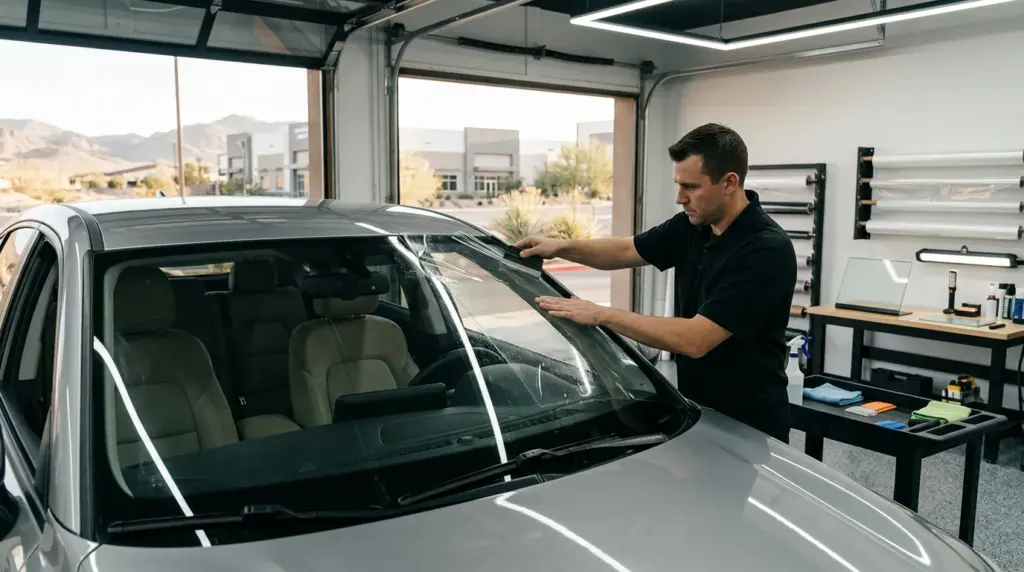
The technician fits the transparent protective film to the windshield.
Different products may require different shaping and application methods.
A curved windshield can require careful handling to achieve a consistent finish.
Step 5: Edge and Clarity Inspection
After installation, the shop should check:
- Overall clarity
- Edge placement
- Film alignment
- Visible contamination
- Bubbles or other defects
- Wiper contact areas
- Compatibility with vehicle equipment
Step 6: Maintenance Instructions
Before pickup, ask the installer to explain cleaning restrictions, wiper blade recommendations, and how to report an issue.
Dipped Auto Works’ windshield protection film service includes consultation and professional installation.
The team can discuss the product’s features and review suitability for your vehicle.
Insurance and Warranty Considerations for Windshield Protection Film
Before selecting film, it’s worth considering how glass claims and product warranties work.
Does Auto Insurance Cover Windshield Protection Film?
Do not assume that an insurance policy covers aftermarket windshield protection film.
Glass coverage, comprehensive coverage, deductibles, and aftermarket accessory coverage vary by policy.
An insurer may cover certain glass damage without automatically covering a protective film installed over the windshield.
Ask your insurer how it treats aftermarket windshield film if the glass is damaged or replaced.
Does Windshield Film Have a Manufacturer Warranty?
Some products do.
XPEL’s official FAQ describes a one-year/12,000-mile limited warranty covering specified manufacturing defects.
These include certain conditions involving peeling, cracking, yellowing, bubbling, hazing, and delamination.
The written warranty controls the details and exclusions.
Are Rock Chips Covered Under That Warranty?
XPEL states that rock chips are not covered under its windshield film product warranty.
This matters because the film is intended to take damage before the glass does.
A stone marking the film doesn’t automatically mean the material was defective.
Is the Shop’s Warranty the Same as the Manufacturer’s Warranty?
Not necessarily.
A manufacturer may warrant the film itself against specified defects.
The installer may provide separate workmanship terms.
Ask for both sets of information before making a decision.
Is Windshield Protection Film Worth It for Your Vehicle? A Checklist
Before scheduling windshield protection film in Las Vegas, NV, consider how your vehicle is used and what you expect from the product.
Windshield Condition
- My windshield is free from unrepaired chips or cracks.
- I know whether my glass has factory coatings or special features.
- The installer has checked for existing surface damage.
Vehicle Compatibility
- The exact film is designed for automotive windshields.
- The vehicle manufacturer permits the proposed application.
- Cameras and sensors have been considered.
- The film’s optical characteristics have been reviewed.
- Nevada legal requirements have been checked.
Protection Expectations
- I understand that film reduces certain risks but cannot stop every crack.
- I know the film itself can develop scratches.
- I understand it may eventually need replacement.
- I have reviewed the manufacturer’s warranty exclusions.
Maintenance
- I am willing to maintain suitable wiper blades.
- I will follow the film’s cleaning instructions.
- I know when the film can first be washed.
- I know what to do if haze or scratches develop.
Installation Questions
- Which XPEL windshield film product will be used?
- What legal documentation supports its installation?
- What does the warranty cover?
- What are the required maintenance products?
- How is damaged or worn film replaced?
- Will the film affect any factory windshield equipment?
The more of these questions you can answer before installation, the easier it becomes to decide whether the service is appropriate.
Windshield Protection Film in Las Vegas, NV: 7 Frequently Asked Questions
1. Is windshield protection film worth it in Las Vegas, NV?
It can be worth considering if you frequently encounter road debris and want to reduce the chance of certain rock impacts damaging your windshield.
The film acts as a sacrificial barrier over the glass.
It cannot stop every impact, and it may require maintenance or replacement.
You should also confirm that the proposed film is compatible with your vehicle and permitted under Nevada law.
2. Does windshield protection film prevent cracks?
Windshield protection film is designed to help reduce the risk of chips and cracks from certain impacts.
It does not make the glass unbreakable.
A large stone or strong impact can still damage the windshield.
It also should not be relied upon to stop existing cracks from spreading.
3. How long does windshield protection film last in Las Vegas?
Lifespan depends on the film, travel conditions, cleaning, wiper contact, and outdoor exposure.
XPEL currently lists a one-year/12,000-mile limited product warranty for its windshield protection film.
That warranty does not establish a fixed replacement date.
Inspect the film regularly and arrange replacement if wear affects its clarity or performance.
4. Can windshield protection film scratch?
Yes.
Windshield films may scratch from wiper contact, abrasive grit, improper cleaning, and road debris.
XPEL recommends new premium windshield wiper blades when installing its product.
Gentle cleaning and maintaining the wipers can help reduce avoidable surface damage.
5. Is clear windshield protection film legal in Nevada?
Not automatically.
NRS 484D.440 generally prohibits applying aftermarket transparent material to a covered vehicle’s windshield if it alters color or reduces light transmission, unless an exception applies.
A product that appears clear may still affect light transmission.
Have the specific application reviewed under the applicable law before installation.
6. Does windshield protection film interfere with cameras or ADAS?
It depends on the vehicle and product.
Some vehicle manufacturers restrict materials in areas used by forward-facing cameras.
The installer should check the vehicle manufacturer’s instructions and any relevant sensor requirements.
Never assume that a clear film is compatible with every camera system.
7. Where can I ask about windshield protection film in Las Vegas, NV?
You can contact Dipped Auto Works at 4305 Dean Martin Dr #120, Las Vegas, NV 89103.
Our XPEL-certified team provides windshield protection film consultations and can discuss the available product, windshield condition, maintenance requirements, and vehicle compatibility.
Call (702) 379-8716 or visit our contact page to request an appointment.
Ask Dipped Auto Works About Windshield Protection Film in Las Vegas, NV
If you frequently hear rocks striking your windshield, windshield protection film may be worth considering.
It adds a transparent protective layer designed to reduce damage from some stones and road debris.
But the film isn’t invisible under every possible viewing condition, and it cannot guarantee that your windshield will never chip or crack.
Its suitability depends on legal requirements, vehicle compatibility, optical clarity, and how you plan to maintain it.
At Dipped Auto Works, we help vehicle owners in Las Vegas, NV, understand their automotive protection options.
We also serve customers coming from Henderson, NV, and Summerlin, NV.
Our related services include:
- Windshield Protection Film
- Paint Protection Film
- Ceramic Coating
- Automotive Window Tint
- Tesla Paint Protection Film
- Auto Detailing
Our team can review your windshield’s condition, explain the XPEL product’s features, and discuss any compatibility or legal concerns that need to be resolved before installation.
Contact Dipped Auto Works
Business Name: Dipped Auto Works
Address: 4305 Dean Martin Dr #120, Las Vegas, NV 89103
Phone: (702) 379-8716
Business Hours: Monday through Saturday, 9 AM to 6 PM
Website: www.dippedautoworks.com
Schedule an Appointment: Contact Dipped Auto Works
Want to find out whether windshield protection film makes sense for your vehicle?
Call (702) 379-8716 or fill out our contact form to request a windshield protection consultation.
Tell us your vehicle’s year, make, and model, whether the windshield has existing damage, and how you typically use the vehicle.
We’ll help you review the available protection options, maintenance requirements, and whether the proposed treatment is appropriate for your windshield.
Sources and References
The following sources support the information about windshield protection film, impact resistance, care requirements, product warranties, vehicle safety, Nevada law, and local services.
1. Windshield Protection Film
- Publisher: XPEL
- Publication Date: Not listed
- URL: https://www.xpel.com/products/windshield-protection-film
2. Frequently Asked Questions: Windshield Protection Film
- Publisher: XPEL
- Publication Date: Not listed
- URL: https://www.xpel.com/faqs?q=faq_paint_protection
3. Product Care: Windshield Protection Film
- Publisher: XPEL
- Publication Date: Not listed
- URL: https://www.xpel.com/product-care
4. ClearPlex Windshield Protection Film
- Publisher: Madico
- Publication Date: Not listed
- URL: https://madico.com/automotive/windshield-protection-film/clearplex
5. NRS 484D.440: Restrictions on Tinting of Windshield or Side or Rear Window
- Publisher: Nevada Legislature
- Publication Date: Current online statutory compilation; webpage date not listed
- URL: https://www.leg.state.nv.us/NRS/NRS-484D.html#NRS484DSec440
6. NAC Chapter 484D: Vehicle Equipment Regulations
- Publisher: Nevada Legislature
- Publication Date: Individual regulations have different effective dates
- URL: https://www.leg.state.nv.us/NAC/NAC-484D.html
7. EyeSight Windshield Area Precautions
- Publisher: Subaru of America; technical service document hosted by NHTSA
- Publication Date: 2013
- URL: https://static.nhtsa.gov/odi/tsbs/2013/MC-10232549-9999.pdf
8. Las Vegas 1991-2020 Climate Normals
- Publisher: National Weather Service, NOAA
- Publication Date: 2021 climate normals release; webpage date not listed
- URL: https://www.weather.gov/vef/1991-2020Normals
9. Windshield Protection Film in Las Vegas, NV
- Publisher: Dipped Auto Works
- Publication Date: Not listed
- URL: https://dippedautoworks.com/services/windshield-protection-film/
10. Automotive Paint Protection Film
- Publisher: Dipped Auto Works
- Publication Date: Not listed
- URL: https://dippedautoworks.com/services/paint-protection-film/
11. Automotive Window Tint
- Publisher: Dipped Auto Works
- Publication Date: Not listed
- URL: https://dippedautoworks.com/services/window-tint/
Best Color Change Wraps in Las Vegas, NV: A Comprehensive Guide

Discover the best color change wraps in Las Vegas, NV, with Dipped Auto Works. From choosing the perfect color to expert installation, learn how to transform your car with a vinyl wrap that suits your style and protects your vehicle. Call (702) 379-8716 to schedule your consultation today!
Product Brand: Dipped Auto Works
5
Pros
- Discover the best color change wraps in Las Vegas, NV, with Dipped Auto Works. From choosing the perfect color to expert installation, learn how to transform your car with a vinyl wrap that suits your style and protects your vehicle. Call (702) 379-8716 to schedule your consultation today!
