
PPF and ceramic coating in Enterprise, NV, are two popular ways to protect your vehicle’s paint from everyday wear and keep it looking great. If you’ve noticed rock chips on your hood, dust collecting on your car, or water spots appearing after a wash, you might be wondering which service makes the most sense. Should you install paint protection film, apply ceramic coating, or combine both?
The answer depends on what you’re trying to protect against. Paint protection film (PPF) adds a physical barrier over painted surfaces to help reduce damage from rocks, debris, and minor scratches. Ceramic coating creates a water-repellent surface that helps keep dirt from sticking and makes regular washing easier.
For vehicle owners in Enterprise, NV, these services can be useful because of the area’s desert climate, sunny weather, and everyday roadway conditions. Whether you own a Tesla, BMW, Mercedes-Benz, sports car, or family SUV, protecting your exterior starts with knowing what each product can and cannot do.
At Dipped Auto Works, we provide professional paint protection film and ceramic coating services for vehicle owners in Enterprise, NV. Our certified installation team can help you compare the options, inspect your paint, and select coverage that suits your vehicle.
Let’s look at how these services work, when combining them makes sense, and what to expect before scheduling an appointment.
Table of Contents
- Why Vehicle Paint Protection Matters in Enterprise, NV
- What Is Paint Protection Film?
- What Is Ceramic Coating?
- PPF vs Ceramic Coating: What’s the Difference?
- Can You Combine PPF and Ceramic Coating?
- Choosing the Right PPF Coverage
- Ceramic Coating Options for Your Vehicle
- Which Vehicles Benefit From Both Services?
- What Happens During Installation?
- Maintaining PPF and Ceramic Coating
- Choosing a Local PPF and Ceramic Coating Installer
- PPF and Ceramic Coating Frequently Asked Questions
- Schedule Your Vehicle Protection Consultation
- Sources and References
Why PPF and Ceramic Coating Matter in Enterprise, NV
Enterprise, NV, sits in the southwest portion of the Las Vegas Valley. According to Clark County’s Enterprise planning information, it is an unincorporated town covering approximately 67 square miles.
Vehicle owners in the area experience the same general desert weather patterns found throughout the valley.
The National Weather Service’s 1991-2020 Climate Normals show that the nearby Las Vegas weather station averages only 4.18 inches of precipitation annually.
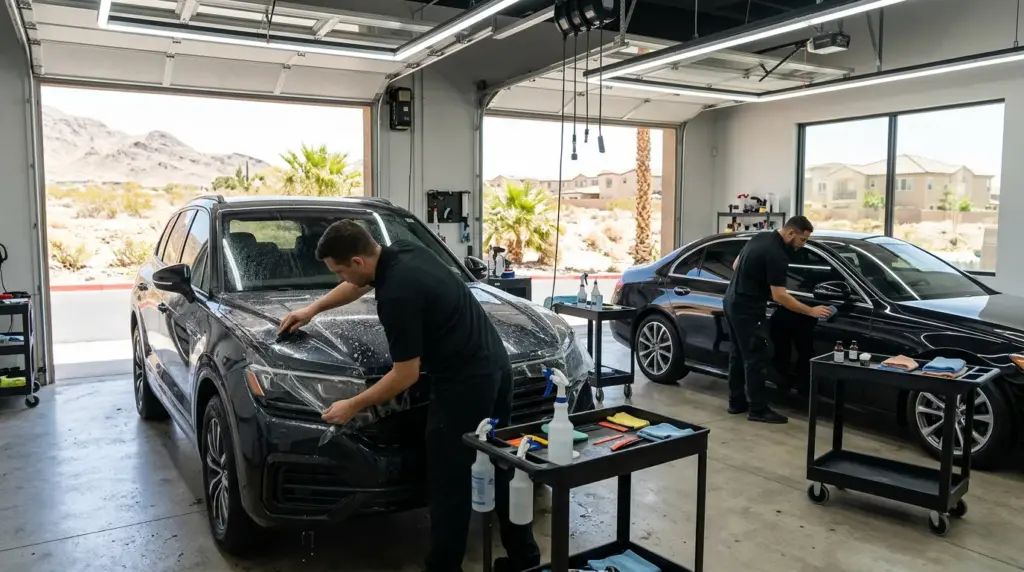
Low rainfall doesn’t mean vehicles stay clean. Dust, road grime, insects, and loose roadway debris can still collect on painted surfaces.
Road Debris and Rock Chips
Small stones thrown up by passing traffic can strike your vehicle’s front bumper, hood, mirrors, and fenders.
Even a small impact can leave a chip in the clear coat or painted surface.
These marks are frustrating because washing and polishing cannot repair paint that has been chipped away.
PPF places a protective film over vulnerable panels to absorb many of these everyday impacts.
Desert Dust and Washing Scratches
Dust is another reason to pay attention to exterior care.
When fine particles settle on your vehicle, wiping them away with a dry towel can scratch the surface.
Ceramic coating can make washing easier because its water-repellent properties help reduce how strongly some contamination clings to the exterior.
PPF provides protection against certain light abrasions on the panels it covers.
Neither product eliminates the need for careful washing.
Strong Sunshine and Outdoor Parking
Long periods of sunshine can make maintaining exterior surfaces a regular concern for vehicle owners.
Some automotive films and coatings are designed to resist UV exposure and outdoor weathering.
Their performance depends on the exact product, how it is installed, and how the vehicle is maintained.
If you park outside frequently, ask your installer which product properties and warranty terms apply to your vehicle.
The goal is to protect against the conditions your car actually faces, rather than expecting one product to prevent every type of damage.
What Is Paint Protection Film (PPF)?
Paint protection film is a clear or specialty-finish urethane film installed over exterior vehicle panels.
It creates a physical layer between your paint and materials that might otherwise contact the surface directly.
Modern automotive PPF is commonly used on:
- Front bumpers
- Hoods
- Front fenders
- Side mirrors
- Rocker panels
- Doors
- Rear quarter panels
- Trunk and liftgate surfaces
Some owners protect only the front end, while others cover nearly every painted exterior panel.
How Does PPF Protect Your Paint?
Imagine a small rock striking your front bumper while you’re traveling on the highway.
Without PPF, the rock contacts the vehicle’s clear coat and paint directly.
With PPF installed, the rock first strikes the protective film.
The film may absorb enough of the impact to prevent a chip in the underlying finish.
XPEL ULTIMATE PLUS is one example of automotive PPF designed to resist rock chips, scratches, and other everyday exterior hazards.
PPF cannot prevent all damage. A large stone or forceful impact may penetrate the film and reach the paint.
Still, the added physical barrier can help preserve covered surfaces.
What Is Self-Healing PPF?
Some paint protection films have a self-healing topcoat.
When the topcoat develops minor surface marks, suitable warmth can help those marks become less visible.
This is a feature of selected film products, not every PPF on the market.
Self-healing won’t repair deep cuts or scratches that reach the paint underneath.
If you want this feature, ask your installer which film series will be used.
Does Clear PPF Change Your Car’s Appearance?
Clear gloss PPF is intended to maintain the original look of your vehicle’s paint.
The finish can appear slightly different depending on the film and paint condition, but quality clear film is designed to be difficult to notice when installed properly.
If you’re interested in a different appearance, Dipped Auto Works also offers colored PPF.
You can discuss clear, matte, and specialty films during your consultation.
What Is Ceramic Coating?
Ceramic coating is a liquid-applied protective product that bonds to a properly prepared vehicle surface.
Once cured, it creates a thin protective layer that can improve gloss, repel water, and help reduce the adhesion of certain contaminants.
Unlike PPF, ceramic coating is not a thick film.
It is designed mainly for surface protection and easier maintenance rather than absorbing stone impacts.
What Does Ceramic Coating Actually Do?
A professionally applied automotive ceramic coating can provide benefits such as:
- Water-repellent surface behavior
- Easier removal of some road grime
- Improved gloss and paint appearance
- Resistance to certain environmental contaminants
- Reduced need for frequent waxing
- Protection against some forms of weathering
The XPEL FUSION PLUS ceramic coating product line is designed for these types of exterior maintenance benefits.
Water repellency is often one of the most noticeable effects.
When water contacts a coated surface, it tends to form beads or move across the panel more readily.
This can help make routine washing and drying easier.
What Ceramic Coating Cannot Do
Ceramic coating isn’t a substitute for paint protection film.
It will not reliably prevent:
- Rock chips from highway debris
- Deep scratches
- Parking lot door impacts
- Damage from collisions
- Severe abrasion
- Every type of water spot
A ceramic-coated vehicle can still get scratched.
Water can also leave mineral deposits on a coated surface, especially if it dries before being removed.
For owners considering PPF and ceramic coating in Enterprise, NV, understanding these limits makes choosing the right service much easier.
Is Ceramic Coating Better Than Wax?
Traditional automotive waxes and many paint sealants provide temporary surface protection.
Professional ceramic coatings are designed for longer-lasting surface bonding, although their lifespan depends on the product and maintenance.
The main appeal is that a properly maintained ceramic coating can keep providing hydrophobic behavior well beyond the usual service period of many conventional wax products.
You’ll still need to wash the car regularly.
Ceramic coating makes care easier. It doesn’t make the vehicle maintenance-free.
PPF vs Ceramic Coating: What’s the Difference?
The biggest difference between PPF and ceramic coating is the type of protection each product provides.
PPF helps protect against physical impacts.
Ceramic coating helps manage surface contamination and makes exterior cleaning easier.
Here’s a side-by-side comparison.
| Feature | Paint Protection Film | Ceramic Coating |
|---|---|---|
| Physical rock chip protection | Helps protect covered panels | Not designed for rock impacts |
| Minor scratch protection | Yes, depending on the film and impact | Limited surface resistance |
| Self-healing properties | Available on selected films | Not a typical ceramic coating feature |
| Water repellency | Depends on the film’s topcoat | One of the main benefits |
| Easier cleaning | Can help, depending on the film | Yes |
| Exterior gloss | Maintains or changes finish based on film | Can improve visible gloss |
| Full vehicle coverage | Available for suitable exterior panels | Available on approved exterior surfaces |
| Installation method | Physical film application | Liquid coating application |
| Surface preparation | Required | Required |
| Maintenance | Regular washing | Regular washing |
Choose PPF When Rock Chips Are Your Main Concern
If you’re worried about damage to the front bumper and hood, PPF is the more suitable product.
It creates a barrier designed to take contact from stones and debris.
This is helpful for vehicles that see frequent highway travel.
Choose Ceramic Coating When Easier Washing Is Your Main Concern
If you spend time cleaning dust, bug residue, and road grime from your vehicle, ceramic coating may be the service that matches your needs.
The hydrophobic surface can help reduce the effort needed for routine cleaning.
Ceramic coating is also worth considering if you enjoy maintaining a glossy, clean-looking finish.
Choose Both When You Want Two Types of Protection
For owners who care about rock chips and cleaning, combining the services may make sense.
This doesn’t mean every vehicle needs both.
It means PPF and ceramic coating can address different concerns on the same car.
Can You Combine PPF and Ceramic Coating on the Same Vehicle?
Yes. Compatible ceramic coatings can be applied over many paint protection films.
This is one of the most useful things to understand about PPF and ceramic coating in Enterprise, NV.
The two products don’t have to compete for the same role.
The PPF provides a physical protective layer, while the ceramic coating can make the outer surface more water-repellent and easier to clean.
XPEL explains that selected FUSION PLUS ceramic coatings are designed to work with PPF.
Product compatibility should always be confirmed before application.
How Does PPF With Ceramic Coating Work?
Consider a vehicle with clear PPF covering the front bumper, full hood, and front fenders.
The film protects those painted panels from many small impacts.
A compatible ceramic coating can then be applied to the film, following the manufacturer’s installation instructions.
The remaining painted panels can also receive a suitable ceramic coating after preparation.
You end up with physical film protection on selected areas and a water-repellent coating across the approved exterior surfaces.
Does Ceramic Coating Make PPF Stronger?
Ceramic coating doesn’t turn PPF into an impact-proof material.
It also doesn’t replace the film’s ability to absorb contact from roadway debris.
Its main contribution is to the outer surface, where it may improve water repellency, gloss, and cleaning behavior.
Some PPF products already have hydrophobic topcoats, so an additional coating may not be necessary for every owner.
Ask your installer whether the selected film would benefit from a separate ceramic application.
Should PPF Be Installed Before Ceramic Coating?
When both services are planned together, the usual sequence is to prepare the paint, install the film, and then apply a compatible coating after the film is ready.
Putting a coating on the paint before installing adhesive-backed film may interfere with the film’s bonding requirements.
Your installer should confirm the order of work for the exact products selected.
Here’s why that matters: proper surface preparation and product compatibility can affect the finished appearance and long-term behavior of both protective layers.
Choosing PPF Coverage for Your Vehicle in Enterprise, NV
Not everyone wants to protect the same panels.
At Dipped Auto Works, our published PPF coverage options include front bumper, partial front, full front, and full vehicle packages.
Front Bumper PPF
Front bumper protection focuses on one of the vehicle’s most exposed painted surfaces.
It’s a reasonable choice when your main concern is incoming debris striking the bumper.
The hood, fenders, and other panels remain uncovered unless you request extra film.
Partial Front PPF
Our published partial front package includes the front bumper, partial hood, partial front fenders, and mirrors.
This gives the vehicle more coverage than a bumper-only installation.
Because only part of the hood and fenders are covered, visible film boundaries may remain.
Ask the installer where those edges will appear.
Full Front PPF
Our published full front package includes the front bumper, full hood, full front fenders, mirrors, and headlights, subject to vehicle suitability and installation requirements.
Full hood coverage avoids a film boundary across the center of the hood.
For many owners who are mainly concerned about highway debris, this is a practical coverage option.
Full Body PPF
Full body PPF extends protection across the painted exterior.
It commonly includes doors, rear quarter panels, rear bumper, and trunk or liftgate surfaces along with front-end panels.
The precise coverage depends on the vehicle and selected installation plan.
Full body film may be worth considering if you want to protect a larger portion of your original paint.
What About Rocker Panels and Rear Loading Areas?
Some vehicle owners need protection outside standard front-end packages.
Rocker panels near the wheels can be exposed to stones and grime.
Painted rear loading edges can receive scratches from luggage, equipment, and other items.
Ask whether those areas can be included in your installation.
Ceramic Coating Options for Enterprise, NV Vehicle Owners
PPF coverage is usually described by the vehicle panels receiving film.
Ceramic coating packages may be organized by product, coating layers, covered surfaces, and warranty terms.
Dipped Auto Works currently publishes multiple ceramic coating packages, including options labeled two-year, five-year, and lifetime.
What Does a Ceramic Coating Package Cover?
Our published coating packages list treatment for exterior areas such as:
- Painted body panels
- Wheel faces
- Automotive glass
- Exterior vinyl and plastic surfaces
- Headlights and taillights
Exact coverage should always be confirmed for your vehicle.
Different materials can require different coating products.
A coating intended for painted body panels may not be appropriate for every glass, plastic, or trim surface.
Do More Ceramic Coating Layers Mean Better Protection?
Not automatically.
The number of coating layers is only one part of the service.
The coating formulation, surface preparation, application method, curing, and maintenance requirements also matter.
Ask what each package includes rather than choosing based only on the number of layers.
What About Ceramic Coating Warranties?
A warranty may cover certain product or service concerns, but it doesn’t mean your vehicle can go without regular care.
Dipped Auto Works carries warranties on its products and services.
Ask for the written terms associated with your chosen coating package, including maintenance requirements and exclusions.
Which Vehicles Benefit From PPF and Ceramic Coating?
You don’t need an exotic sports car to benefit from exterior paint protection.
The right services depend more on the vehicle’s use, condition, and your preferences.
Tesla Model 3 and Model Y
Tesla owners often focus on the front bumper, hood, fenders, and rocker panels.
These areas may face roadway debris during regular travel.
A Model Y owner may also want protection near the rear cargo opening.
For Teslas, Dipped Auto Works offers dedicated Tesla paint protection film and Tesla ceramic coating services.
You can compare partial coverage, full front protection, and broader exterior treatment.
BMW, Mercedes-Benz, and Audi
Luxury sedans and SUVs often have complex front bumpers, mirrors, trim sections, and painted body contours.
Film placement should account for the vehicle’s shape and factory components.
Owners who want to preserve the original finish may choose full front PPF, then discuss ceramic coating for easier exterior maintenance.
Porsche, Ferrari, and Lamborghini
Sports cars can have low front bumpers, side skirts, wide rear sections, and body panels with unusual shapes.
These features may call for a carefully planned installation.
Some owners prefer full body coverage, while others concentrate on front-end and lower-body protection.
The installer should review panel boundaries, film edges, and paint condition before recommending a package.
Family SUVs and Everyday Commuters
Family vehicles can pick up marks around door handles, rear bumpers, and loading areas.
They also collect dust and roadway grime just like luxury vehicles.
PPF can protect selected painted areas, while ceramic coating may help with regular washing.
For owners in Enterprise, NV, this combination can make sense for a vehicle used throughout the week.
What Happens During PPF and Ceramic Coating Installation?
A professional installation involves more than applying film or wiping a liquid product onto the paint.
Before work starts, your installer should review the vehicle’s condition and explain the planned steps.
Step 1: Paint Inspection
The installer checks the exterior for existing damage.
This may include:
- Rock chips
- Scratches
- Swirl marks
- Water spots
- Previous body repairs
- Repainted panels
- Surface contamination
Existing imperfections should be discussed before protective products are installed.
Neither PPF nor ceramic coating repairs missing paint.
Step 2: Washing and Surface Preparation
The vehicle needs to be thoroughly cleaned.
Depending on its condition, preparation may include removing bonded contaminants and cleaning residual products from the paint.
If the paint has visible swirl marks or light scratches, the shop may recommend paint correction.
Not every vehicle needs the same level of correction.
Step 3: PPF Installation
If film is part of the plan, the installer places it on the selected panels.
Vehicle curves, edges, sensors, and trim can affect installation.
Ask where any seams or visible film boundaries may remain.
Step 4: Ceramic Coating Application
After the film is ready and the remaining surfaces are prepared, the installer applies the appropriate ceramic coating.
The coating needs to cure according to its product instructions.
The shop should explain when the vehicle can be washed and whether any early care restrictions apply.
Step 5: Final Inspection and Aftercare
Before pickup, you should have the chance to review the finished surfaces.
Ask for the film and coating product names, warranty documentation, and washing instructions.
If something doesn’t look right after installation, contact the shop instead of attempting to correct it yourself.
How to Maintain PPF and Ceramic Coating in Enterprise, NV
Once you’ve installed PPF and ceramic coating, regular care helps both products perform as intended.
Dust can accumulate on the surface, and water can leave spots if it dries with minerals or dirt present.
A protected vehicle still needs careful washing.
Wait Before the First Wash
The waiting period depends on the specific film and coating products.
XPEL’s product care instructions recommend waiting 48 hours after installation before washing vehicles with certain XPEL films.
Ceramic coatings may have separate curing requirements.
Follow the instructions for your particular installation.
Rinse Away Dust Before Touching the Paint
Never assume it’s safe to wipe dust off a dry vehicle.
Start by rinsing away loose particles.
Then use a suitable automotive shampoo and clean washing materials.
A simple wash routine includes:
- Rinse loose dirt from the exterior.
- Wash with a clean microfiber mitt and suitable shampoo.
- Rinse thoroughly.
- Dry with a clean microfiber towel.
- Inspect protected surfaces for any concerns.
Avoid abrasive cleaning tools.
Be Careful Around Film Edges
Pressure washing too close to PPF edges may cause lifting or other damage.
XPEL advises avoiding high-pressure water directly around the film edges.
If you notice a loose edge, contact your installer.
Don’t pull on the film or try to trim it yourself.
Remove Bug Residue and Bird Droppings
Environmental contaminants should be removed promptly using suitable cleaning products.
Don’t leave stubborn residue sitting on the film or coating for extended periods.
If normal washing doesn’t remove it, ask your installer which products are compatible with the surface.
Consider Professional Detailing
Some owners prefer professional cleaning to keep their vehicles looking their best.
Dipped Auto Works offers auto detailing services that can be discussed alongside PPF and ceramic coating care.
Tell the detailer which products are installed so appropriate cleaning methods can be selected.
Choosing a PPF and Ceramic Coating Installer Near Enterprise, NV
When comparing installers, pay attention to the products, preparation work, and warranty information.
The shop should be comfortable answering questions about what will be applied to your vehicle.
Ask These Questions Before Booking
- What brand and product will be installed?
- Which painted panels are included in the PPF package?
- Does the ceramic coating package include glass, wheels, or trim?
- Will the shop inspect the paint beforehand?
- Is paint correction needed?
- Can the selected ceramic coating be applied over the selected film?
- How long should I wait before washing?
- What warranties apply?
- Who should I contact if I notice an issue?
These questions help you compare the actual work rather than relying only on package names.
Why Choose Dipped Auto Works?
Dipped Auto Works is a certified auto restyling and vehicle protection shop serving Enterprise, NV, from our location in Las Vegas, NV.
Our services include paint protection film, ceramic coating, colored PPF, paint correction, and auto detailing.
We also provide warranties on our products and services.
Our team can inspect your vehicle, discuss the surfaces you’re concerned about, and explain the available coverage options.
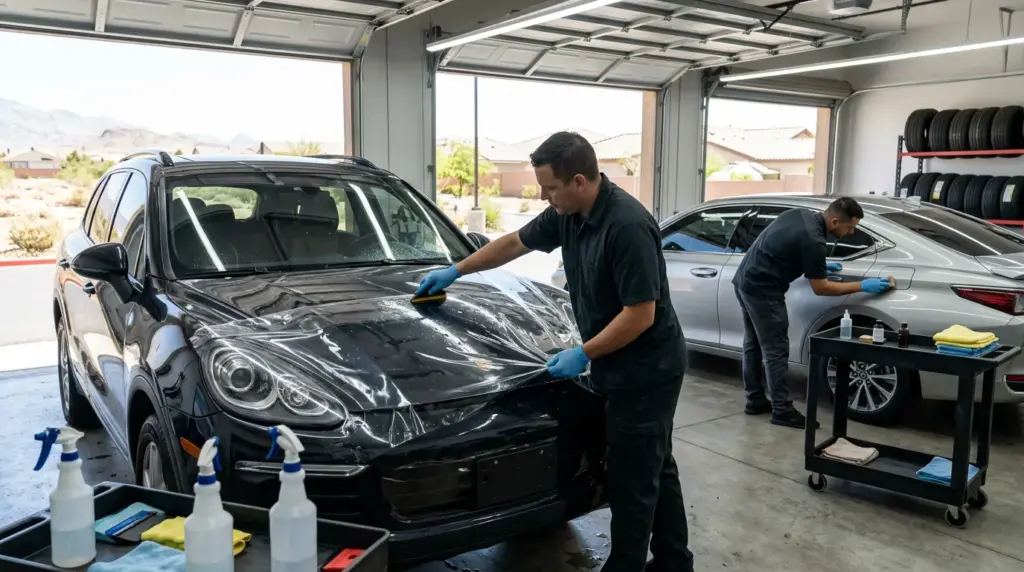
We want you to know what you’re getting before the installation begins.
PPF and Ceramic Coating in Enterprise, NV: 7 Frequently Asked Questions
1. Is PPF or ceramic coating better for a car in Enterprise, NV?
It depends on the damage or maintenance concern you want to address.
PPF is the better choice when you’re worried about rock chips and certain scratches on painted panels.
Ceramic coating is better suited to improving water repellency, gloss, and routine cleaning.
If you want both types of protection, ask about combining compatible products.
2. Can ceramic coating be applied over paint protection film?
Yes. Certain ceramic coatings are designed for use over automotive PPF.
XPEL offers FUSION PLUS coating products that are compatible with selected paint protection films.
Your installer should confirm that the products work together and follow the proper application sequence.
An extra coating isn’t required for every film.
3. Do I need full body PPF if I’m getting ceramic coating?
No.
You can install PPF on selected high-exposure areas and use ceramic coating on suitable exterior surfaces.
Some owners choose full front film with ceramic coating across the remaining painted panels.
Others prefer full body PPF with a compatible coating.
Your choice depends on which surfaces you want protected from physical contact.
4. Will ceramic coating prevent rock chips?
No. Ceramic coating isn’t designed to absorb rock impacts in the same way as paint protection film.
For protection against small stones and roadway debris, PPF is the more appropriate service.
Ceramic coating can help with cleaning and certain surface contaminants, but it will not make your paint chip-proof.
5. How long do PPF and ceramic coating last?
The lifespan depends on the exact products, installation, exposure, and maintenance.
Dipped Auto Works currently lists a five-year warranty with its published PPF packages and ceramic coating packages with different warranty periods.
Some XPEL films have longer limited manufacturer warranties.
Ask for the written terms of each product and service before scheduling.
Warranty duration is not a guarantee against all wear or damage.
6. Can I apply PPF and ceramic coating to an older vehicle?
Yes, provided the surfaces are suitable for installation.
Older vehicles may need extra preparation because of existing scratches, contamination, repainting, or clear coat concerns.
An inspection can help determine whether paint correction or repairs are recommended before applying film or coating.
Clear PPF won’t hide all existing paint damage.
7. Where can I get PPF and ceramic coating near Enterprise, NV?
Dipped Auto Works serves vehicle owners in Enterprise, NV, from our shop at 4305 Dean Martin Dr #120, Las Vegas, NV 89103.
Our team offers professional paint protection film, ceramic coating, paint correction, and related exterior care services.
You can call (702) 379-8716 or visit our contact page to schedule a consultation.
Schedule PPF and Ceramic Coating Near Enterprise, NV, at Dipped Auto Works
Choosing between PPF and ceramic coating starts with knowing what you want from your vehicle’s exterior.
If your biggest concern is damage from small rocks, start by looking at paint protection film.
If you’re tired of dealing with dust, grime, and difficult washing, ceramic coating may be a good fit.
If you want to protect selected painted panels while making the exterior easier to maintain, ask about combining both services.
At Dipped Auto Works, we help vehicle owners in Enterprise, NV, compare PPF and ceramic coating options without guessing what each product can do.
Our certified team offers:
- Front bumper PPF
- Partial front paint protection film
- Full front PPF
- Full body PPF
- Colored paint protection film
- Ceramic coating
- Paint correction
- Auto detailing
We work with everyday vehicles, Teslas, luxury sedans, SUVs, and performance cars.
Whether your vehicle is new or you’ve owned it for years, we’ll discuss its condition and the protection options available.
Contact Dipped Auto Works
Business Name: Dipped Auto Works
Address: 4305 Dean Martin Dr #120, Las Vegas, NV 89103
Phone: (702) 379-8716
Business Hours: Monday through Saturday, 9 AM to 6 PM
Website: www.dippedautoworks.com
Schedule an Appointment: Contact Dipped Auto Works
Ready to protect your vehicle?
Call (702) 379-8716 or fill out our contact form to request a personalized consultation.
Tell us your vehicle’s year, make, and model, along with whether you’re interested in PPF, ceramic coating, or both.
We’ll help you compare the available products, understand coverage options, and plan the next steps for protecting your vehicle’s paint.
Sources and References
The following sources support the information about paint protection film, ceramic coating, product compatibility, vehicle care, climate conditions, and local service availability.
1. ULTIMATE PLUS Paint Protection Film
- Publisher: XPEL
- Publication Date: Not listed
- URL: https://www.xpel.com/products/ultimate-plus
2. Automotive Ceramic Coating, FUSION PLUS
- Publisher: XPEL
- Publication Date: Not listed
- URL: https://www.xpel.com/products/automotive-ceramic-coating
3. Choosing the Right Ceramic Coating for Your Vehicle With XPEL FUSION PLUS
- Publisher: XPEL
- Publication Date: April 30, 2023
- URL: https://www.xpel.com/blog/choosing-right-ceramic-coating-your-vehicle-xpel-fusion-plus
4. XPEL Product Care Instructions
- Publisher: XPEL
- Publication Date: Not listed
- URL: https://www.xpel.com/product-care
5. 1991-2020 Climate Normals
- Publisher: National Weather Service, NOAA
- Publication Date: 2021 release; webpage date not specified
- URL: https://www.weather.gov/vef/1991-2020Normals
6. Enterprise Planning Information
- Publisher: Clark County, Nevada
- Publication Date: Not listed
- URL: https://www.clarkcountynv.gov/government/departments/comprehensive_planning_department/divisions/advanced_planning_division/enterprise
7. Paint Protection Film
- Publisher: Dipped Auto Works
- Publication Date: Not listed
- URL: https://dippedautoworks.com/services/paint-protection-film/
8. Ceramic Coating
- Publisher: Dipped Auto Works
- Publication Date: Not listed
- URL: https://dippedautoworks.com/services/ceramic-coating/
9. Paint Correction
- Publisher: Dipped Auto Works
- Publication Date: Not listed
- URL: https://dippedautoworks.com/services/paint-correction/
Best Color Change Wraps in Las Vegas, NV: A Comprehensive Guide
Discover the best color change wraps in Las Vegas, NV, with Dipped Auto Works. From choosing the perfect color to expert installation, learn how to transform your car with a vinyl wrap that suits your style and protects your vehicle. Call (702) 379-8716 to schedule your consultation today!
Product Brand: Dipped Auto Works
5
Pros
- Discover the best color change wraps in Las Vegas, NV, with Dipped Auto Works. From choosing the perfect color to expert installation, learn how to transform your car with a vinyl wrap that suits your style and protects your vehicle. Call (702) 379-8716 to schedule your consultation today!
